
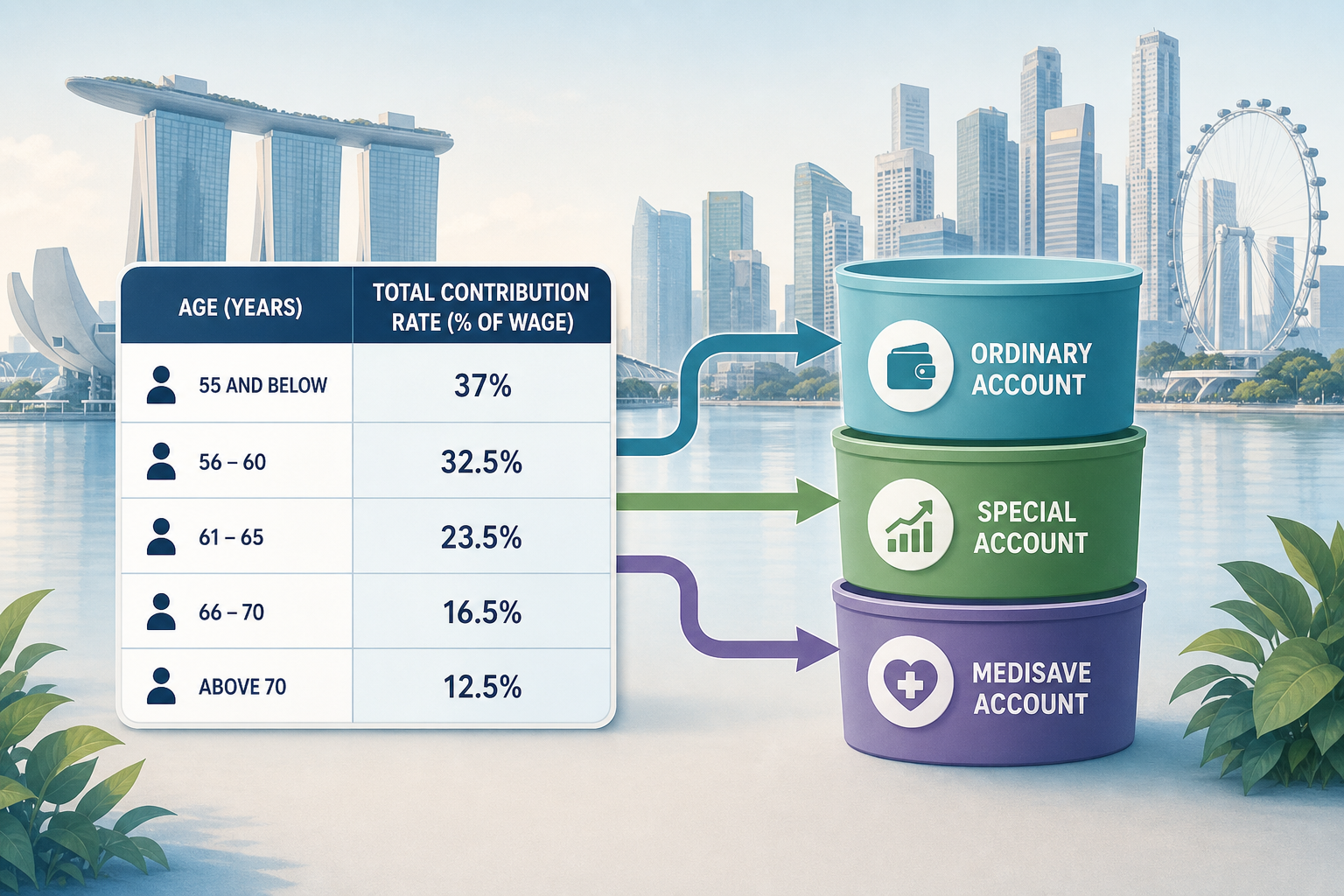
Who is actually subject to CPF contributions
CPF applies only to Singapore Citizens and Permanent Residents employed in Singapore. Work pass holders, including Employment Pass and S Pass holders, are not subject to CPF, and neither are foreigners on dependent or long-term visit passes. Before you run any calculation, confirm the employee's residency status. Getting this wrong in either direction creates real compliance problems: under-contributing exposes the employer to penalties, while deducting CPF from an ineligible employee creates a payroll error that has to be corrected. Once eligibility is confirmed, the next question is which rate table applies.
How age groups and wage ceilings shape the rates
CPF contribution rates are not flat. They vary by the employee's age bracket and by the level of wages paid. Younger employees and their employers contribute at the highest rates, and those rates taper progressively as the employee moves through older age bands, reflecting the policy intent of making older workers less costly to employ. Wages are also split into two categories for CPF purposes: Ordinary Wages (OW), which are wages earned in the month they are paid (such as basic salary), and Additional Wages (AW), which are payments like bonuses or commissions that are not tied to a single month. Each category has its own ceiling, and the calculation method differs between them.
The Ordinary Wage ceiling and what sits above it
The Ordinary Wage ceiling caps the amount of monthly OW that is subject to CPF contributions. Wages paid in a month above that ceiling are not subject to CPF as Ordinary Wages. This matters most for higher-earning employees: if a salary exceeds the ceiling, only the portion up to the ceiling attracts contributions. Separately, there is an Annual Wage Supplement (AWS) ceiling that governs Additional Wages across the full year. The AW ceiling is calculated as the annual CPF wage limit minus the total OW already subject to CPF in that year, so an employee who earns a high ordinary salary throughout the year may have little or no AW ceiling remaining by the time a year-end bonus is paid.
Three CPF accounts and how contributions are allocated
Every CPF member has three accounts: the Ordinary Account (OA), the Special Account (SA), and the MediSave Account (MA). Total contributions are not deposited as a lump sum into one account. Instead, they are split across the three accounts according to allocation rates that also vary by age. Younger members see a larger share going to the OA, which can be used for housing, education, and investment. As members age, the allocation shifts progressively toward MediSave, reflecting higher anticipated healthcare needs. Employers and employees do not need to manage this split themselves; CPF Board applies the allocation automatically once the total contribution is submitted.
Graduated rates for new Permanent Residents
Employees who are newly granted Permanent Residency do not immediately contribute at the full citizen rate. For the first two years of PR status, both the employee and employer contribute at graduated, lower rates. This is sometimes called the SPR (Singapore Permanent Resident) graduated contribution rate. From the third year onward, full rates apply. Employers who miss this distinction and apply full rates from day one are technically over-contributing, which creates a refund process. Applying the wrong rate in the other direction, under-contributing, triggers a shortfall that must be made up with interest.
An employee who turns 55 mid-year moves to a lower rate band from their birthday onward, not from the start of the year, and payroll must reflect that switch in the right month.
How to calculate CPF contributions step by step
Confirm the employee's CPF eligibility
Check whether the employee is a Singapore Citizen or Permanent Resident. Work pass holders and foreigners are not subject to CPF. For PRs, also note the year of PR status, since graduated rates apply in the first two years. Eligibility determines whether any calculation is needed at all, so this step cannot be skipped.
Identify the correct age bracket
CPF rates are published in age bands. Locate the employee's age as of their last birthday and match it to the relevant band in the CPF Board's current rate table. Rates drop at key age thresholds, so an employee who turns 55, 60, 65, or 70 during the year will move to a different rate band from that birthday onward, not from the start of the year.
Separate Ordinary Wages from Additional Wages
Ordinary Wages are wages earned and paid in the same calendar month, such as basic salary and fixed allowances. Additional Wages are payments like bonuses, commissions, and leave encashment that are not tied to a specific month. Each category has its own ceiling, and you must calculate them separately before applying rates.
Apply the Ordinary Wage ceiling
Compare the employee's monthly OW to the current OW ceiling. If OW is at or below the ceiling, the full OW amount is subject to CPF. If OW exceeds the ceiling, only the portion up to the ceiling attracts contributions. Multiply the applicable OW by the total contribution rate (employee plus employer combined) from the rate table.
Calculate the Additional Wage ceiling and apply it
The AW ceiling for the year equals the annual CPF wage limit minus the total OW already subject to CPF in that calendar year. If the AW being paid in a given month is within the remaining AW ceiling, the full AW amount is subject to CPF. If it exceeds the ceiling, only the portion within the ceiling is used. This calculation must be done on a cumulative year-to-date basis, not just for the current month.
Split the total contribution across the three accounts
Once you have the total CPF contribution amount (employee share plus employer share), CPF Board's allocation rates determine how much flows into the Ordinary Account, Special Account, and MediSave Account. These allocation rates also vary by age. You submit the total; CPF Board handles the split automatically when you pay through the CPF e-Submit system.
Benefits
Avoid costly compliance errors
Under-contributing to CPF exposes employers to penalties and interest charges from CPF Board. Getting the rate table and wage ceiling right the first time eliminates the need for corrections, refund applications, and late-payment interest.
Apply the right rate for every age band
CPF rates change at multiple age thresholds. Knowing exactly when to switch rate tables means employees are never over- or under-deducted as they move through different life stages.
Handle bonuses and AW correctly
The Additional Wage ceiling calculation is cumulative and year-to-date. Understanding how it works means year-end bonuses and commissions are processed accurately, with no surprise shortfalls or over-contributions.
Manage PR graduated rates confidently
New PRs attract lower contribution rates for their first two years. Tracking PR grant dates and applying the correct graduated rate prevents the most common new-hire CPF error.
CPF calculation scenarios that trip employers up
Employee turning 55 mid-year
An employee who crosses the age-55 threshold during the year moves to a lower contribution rate band from their birthday onward. Employers who apply the same rate for the entire year will over-contribute for the months before the birthday and under-contribute after it. The correct approach is to switch rate tables from the month of the birthday, not at the start of the financial year. Payroll software that is not updated with the employee's date of birth will not catch this automatically.
Year-end bonus paid to a high-earning employee
A senior employee who has earned a high ordinary salary throughout the year may have exhausted most or all of their AW ceiling by December. When a year-end bonus is paid, the employer must calculate the remaining AW ceiling before deciding how much of the bonus is subject to CPF. If the AW ceiling is already fully used up, no CPF is due on the bonus, even though it is a substantial payment. Missing this calculation results in over-contribution that must be refunded.
New PR employee in their first year
A newly granted PR who joins a company in their first year of residency is subject to graduated CPF rates, not the full citizen rate. Both the employee and employer contribute at lower percentages. Applying full rates from day one is a common payroll error that requires a correction and refund process through CPF Board. The employer should record the PR grant date and set a calendar reminder for when the employee moves to the second-year rate and then to full rates.
Part-time employee with variable monthly wages
Part-time employees who are Singapore Citizens or PRs are subject to CPF on the same basis as full-time employees: the rate table applies to their actual wages, not a prorated version of a full-time salary. If their monthly wages fall below the minimum threshold set by CPF Board, no contribution is required for that month. Employers should check the current minimum wage threshold and verify it against each part-time employee's actual monthly pay before processing.
CPF calculator questions answered
Do Employment Pass holders need CPF contributions?
No. CPF contributions apply only to Singapore Citizens and Permanent Residents. Employment Pass, S Pass, and other work pass holders are not subject to CPF, and employers should not deduct or contribute CPF on their behalf.
What is the Ordinary Wage ceiling and why does it matter?
The Ordinary Wage ceiling is the maximum monthly wage amount on which CPF contributions are calculated. Wages above the ceiling in any given month are not subject to CPF as Ordinary Wages, which means higher-earning employees have a portion of their salary that falls outside the CPF calculation entirely.
How does the CPF calculation change when an employee turns 55?
From the month of the employee's 55th birthday, both the employee and employer contribution rates drop to the rate band for employees aged 55 and above. The switch applies from that birthday month onward, not from the start of the calendar or financial year, so payroll must be adjusted mid-year if the birthday falls between January and November.
What are the three CPF accounts and who decides the split?
Every CPF member has an Ordinary Account, a Special Account, and a MediSave Account. CPF Board automatically allocates the total contribution across the three accounts according to age-based allocation rates. Employers submit the total contribution amount; they do not need to calculate or direct the split themselves.
Can an employer outsource CPF calculation and submission?
Yes. Many Singapore SMEs outsource payroll processing, including CPF calculation and e-submission, to a corporate services or payroll provider. The employer remains legally responsible for correct and timely contributions, but a payroll provider handles the calculation, deduction, and submission mechanics on the employer's behalf.