
Changing a corporate secretary in Singapore requires appointing a qualified replacement and reporting the change to ACRA within 14 days through BizFile+. The company must also keep the role filled at all times after the first six months of incorporation.
Businesses often replace their corporate secretary when switching service providers, updating internal compliance support, or making governance changes. While the process is administrative, it still requires proper documentation and timely filing to avoid penalties. Understanding the steps ahead of time makes the transition smoother and keeps your company compliant.
Keep reading to learn how to change your corporate secretary in Singapore.
Quick compliance snapshot for changing a corporate secretary
Before going through the process, it helps to understand the key rules.
These points explain the most important requirements for a corporate secretary change.
- Every Singapore company must appoint a corporate secretary within six months after incorporation.
- When the secretary changes, the company must report the update to ACRA within 14 days.
- The new secretary must be a natural person who lives in Singapore and is at least 18 years old.
These rules apply to all companies registered in Singapore.
Because of this, companies should plan the change so the resignation date and appointment date match. This avoids leaving the role empty.
Quick comparison of corporate secretary change options
Companies can manage the secretary change in different ways. Some handle the process themselves, while others ask a corporate service provider to assist.
The table below shows common options.
| Option | Typical Cost | Key Responsibility | Suitable For |
| Internal appointment | Minimal administrative cost | Directors manage filings | Small companies with experienced staff |
| DIY filing via BizFile+ | No ACRA filing fee (possible late penalty if >14 days) | Company handles ACRA submission | Simple corporate structures |
| Corporate secretarial provider | SGD 400–2,400 annually | Provider manages compliance | Firms needing administrative support |
Many firms choose the best accounting provider for small businesses to help manage these transitions, though some small companies still choose to file the change themselves. If the company already uses BizFile+, the process can be quick.
Other companies prefer a corporate service provider. The provider prepares filings, tracks deadlines, and keeps company records organized.
What does a corporate secretary do in Singapore companies?

A corporate secretary helps a company follow Singapore company law. The role focuses on compliance records and regulatory filings.
Singapore law requires companies to appoint a corporate secretary within six months after incorporation. After that point, the role must stay filled.
The corporate secretary supports the directors by managing administrative work related to compliance. Directors remain responsible for the company’s legal duties, but the secretary helps prepare the records needed for those duties.
The secretary also acts as the contact point between the company and ACRA.
Typical responsibilities include:
- Maintaining statutory registers for directors, shareholders, and officers
- Filing annual returns and updates through ACRA BizFile+
- Preparing board meeting minutes and written resolutions
- Keeping the company constitution and governance records updated
Companies rely on the corporate secretary to keep records organized and accurate.
These records help show that the company follows regulatory requirements. They may also be reviewed during audits or due diligence checks.
When should a company change its corporate secretary?
Companies change their corporate secretary for several reasons. In many cases, the change happens when the company reviews its compliance support.
Some businesses move to a new provider because they want better service. Others want clearer communication or more reliable help with filings.
Many companies also move to professional corporate secretary services in Singapore that handle compliance work on a regular basis.
Changes in ownership or management can also lead to a secretary change. When directors or shareholders change, companies often review administrative roles.
Common triggers for replacing a secretary
- Dissatisfaction with the current service provider
- Changes in service costs
- Corporate restructuring or governance updates
- The current provider stopping its services
A small company may begin with simple compliance support. As the business grows, its governance needs may increase.
Compliance timing requirements
| Requirement | Rule | Authority |
| Vacancy limit | Secretary cannot be absent for more than six months | Companies Act |
| Filing deadline | Notify change within 14 days | ACRA |
If the company misses the 14‑day filing deadline, ACRA may issue a late lodgement penalty or composition fine, and in more serious or repeated cases, fines can go up to SGD 5,000 under the Companies Act.
Planning the transition early helps prevent this issue.
What eligibility requirements must the new corporate secretary meet?
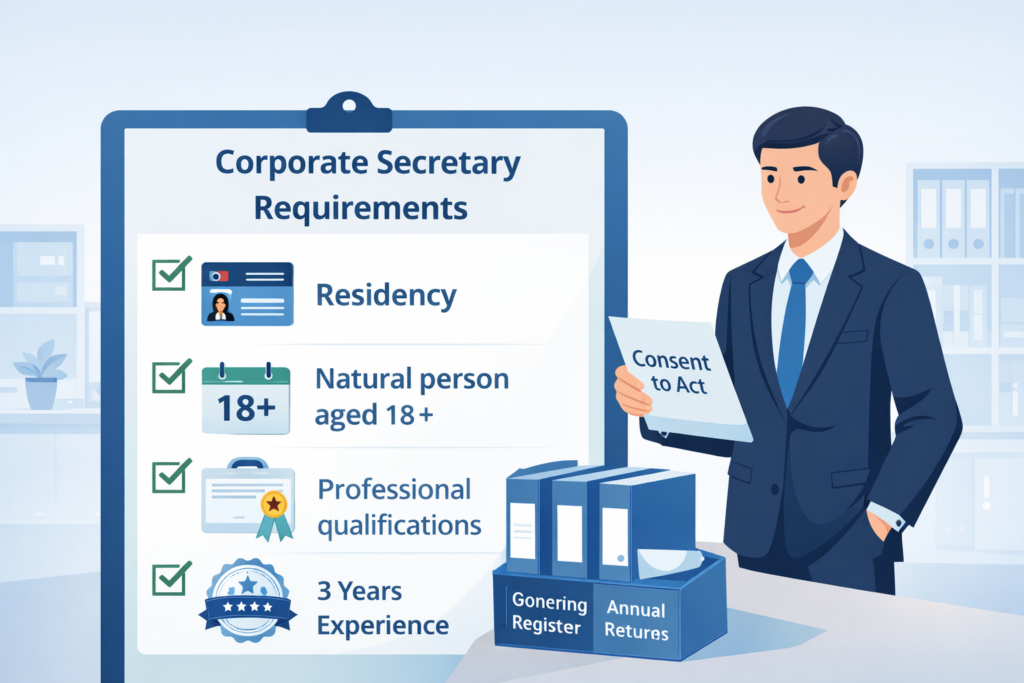
Singapore law sets rules about who can serve as a corporate secretary.
The person must be an individual who is at least 18 years old and lives in Singapore.
The role cannot be held by a company or organization. It must be a natural person.
The person must also have a local address in Singapore.
Residency and legal eligibility
- Must be a Singapore citizen, permanent resident, or holder of a valid work pass
- Must have a Singapore address
- Must be a natural person
Some companies may also require professional experience.
Qualification requirements
- At least three years of secretarial experience within the past five years, or
- Membership in recognized professional bodies such as ICPAS
- Strict for public companies; private companies need someone with suitable knowledge/experience.
Private companies usually have more flexibility when choosing a secretary. Even so, the person should understand compliance tasks.
Another rule applies to directors. If a company has only one director, that person cannot also serve as the corporate secretary.
In that case, the company must appoint another qualified person.
These rules help keep company records accurate.
What is the step-by-step process to change a corporate secretary?
Changing a corporate secretary involves several simple steps.
The company must approve the change, prepare the documents, and file the update through BizFile+.
Once the documents are ready, the process usually moves quickly.
Step 1: Pass a directors’ resolution
The board of directors must approve the change through a written resolution.
This document records the resignation of the outgoing secretary and the appointment of the new one. It also confirms the effective date of the change.
The resolution normally includes:
- Acceptance of the outgoing secretary’s resignation
- Appointment of the new secretary
- Confirmation of the effective date
As noted by ACRA:
“The position of company secretary must not be left vacant for more than 6 months. The sole director of a [company] and the company secretary cannot be the same person.” – ACRA
Board resolutions record the decision made by the directors.
Step 2: Obtain resignation confirmation
The outgoing secretary must confirm the resignation in writing.
This document records the end of the appointment and the date the role ends.
The resignation step often includes:
- A resignation letter from the outgoing secretary
- Transfer of company registers and records
- Review of pending compliance filings
Completing this step helps keep company records clear.
Step 3: Secure consent from the new secretary
Before the appointment takes effect, the new secretary must agree to the role.
This usually happens through a consent form.
The process normally includes:
- Completing Form 45B (Consent to Act as Secretary)
- Confirming residency and eligibility
- Verifying qualifications if needed
This document confirms that the person accepts the appointment.
Step 4: File the change with ACRA via BizFile+
After preparing the documents, the company submits the update through BizFile+.
The filing records both the end of the previous appointment and the start of the new one.
The submission includes:
- Cessation details for the outgoing secretary
- Appointment details for the new secretary
- The effective date of the change
The filing must be completed within 14 days.
In many cases, BizFile+ processes the submission quickly. The update may appear in the company’s public record within about one hour.
What documents are required for the secretary change filing?
Several documents support the secretary change filing.
These documents confirm that the company approved the change and that the new secretary agreed to the appointment.
Preparing them early helps the process move faster.
| Document | Purpose | Responsible Party |
| Board Resolution | Approves resignation and appointment | Directors |
| Resignation Letter | Confirms exit and handover of duties | Outgoing secretary |
| Form 45B | Consent to act as company secretary | New secretary |
| BizFile+ Filing | Official regulatory update | Company representative |
Companies should keep copies of these documents in their statutory registers.
Internal records may also need updates. Board records and company registers should reflect the new secretary.
Accurate records help the company respond to regulatory checks.
Should you change the secretary yourself or hire a corporate service provider?
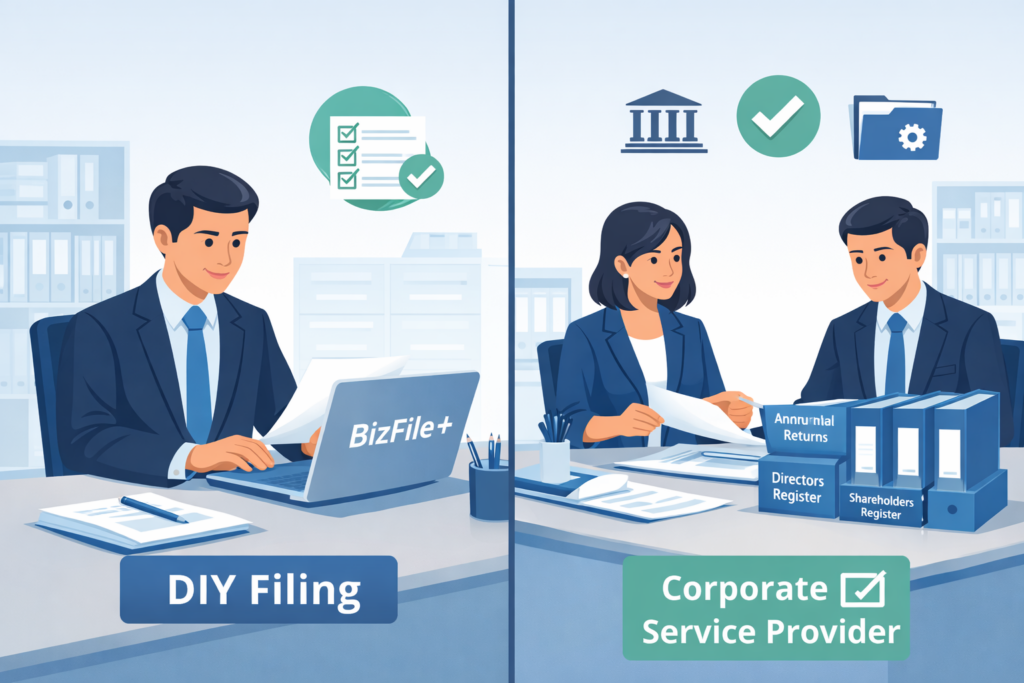
Companies can file the secretary change directly through ACRA. This option works well for businesses with simple structures.
Other companies prefer using a corporate service provider.
DIY filing versus corporate secretarial provider
| Option | Cost Range | Best For |
| DIY filing via ACRA | No ACRA filing fee. | Small private companies |
| Corporate secretarial provider | SGD 400–2,400 annually | Firms needing compliance support |
Service providers often prepare filings, track deadlines, and manage records.
Decision factors to consider
- Company structure complexity
- Number of regulatory filings
- Internal administrative resources
- Need for ongoing governance support
Some companies manage filings internally during early operations. Others move to professional support later, especially when dealing with company incorporation and early compliance requirements in Singapore.
What compliance mistakes should companies avoid during the change?
Even though the process is simple, companies sometimes miss important details.
Most compliance issues involve timing or eligibility.
Common risks include:
- Missing the 14-day filing deadline
- Leaving a gap between resignation and appointment dates
- Appointing someone who does not meet residency requirements
Research from ACRA states:
“You must update the information in Bizfile within 14 days if there are changes to your business particulars such as… Business owners and/or authorised representatives… There is no fee to file these changes. However, a penalty may be imposed for late notification.” – ACRA
These mistakes may lead to rejected filings or penalties.
Prevention checklist
- Align resignation and appointment dates before filing
- Confirm the new secretary meets eligibility rules
- Update company registers after the change
Preparing documents early helps the process run smoothly.
FAQ
How long does it take to change a corporate secretary in Singapore?
The filing itself is quick once the documents are ready. After submission through BizFile+, ACRA often processes the update within about one hour.
Is there a fee to change a corporate secretary with ACRA?
Updating the secretary through BizFile+ usually no fee. Service providers may charge additional fees.
Can a company director also act as the corporate secretary?
Yes. A director may serve as the corporate secretary if the company has more than one director. A sole director cannot hold both roles.
What happens if a company does not report the secretary change to ACRA?
If the company fails to notify ACRA within 14 days, penalties may apply. Late filings may also create problems in company records.
Can a company operate without a corporate secretary?
No. Singapore law requires every company to have a corporate secretary. The role must be filled within six months after incorporation.
Can a company change its corporate secretary multiple times?
Yes. Companies may change their corporate secretary whenever needed. Each change must follow the same process and be reported to ACRA.
Keep your corporate secretary update simple and compliant
Changing a corporate secretary in Singapore involves three main tasks: approving the change, preparing the documents, and filing the update with ACRA.
When companies plan these steps early, the process becomes easier.
Directors should confirm that the new secretary meets the eligibility rules and that the filing deadline is met. Reporting the change on time helps the company stay compliant with Singapore regulations.
If you need guidance on how to change your corporate secretary in Singapore, review your company records and prepare the required documents before filing. This step becomes more important if your company structure also includes roles such as a nominee director arrangement in Singapore.
For help with compliance filings or governance questions, you can contact Duellix to discuss the next steps for your company.
References
- https://www.acra.gov.sg/how-to-guides/setting-up-a-vcc/appointing-directors-company-secretary-and-other-key-persons
- https://www.acra.gov.sg/how-to-guides/updating-information-of-sole-proprietorships-and-partnerships/changes-in-business-information-and-appointments-of-business-owners-and-authorised-representatives/