
What a UEN actually is and why it exists
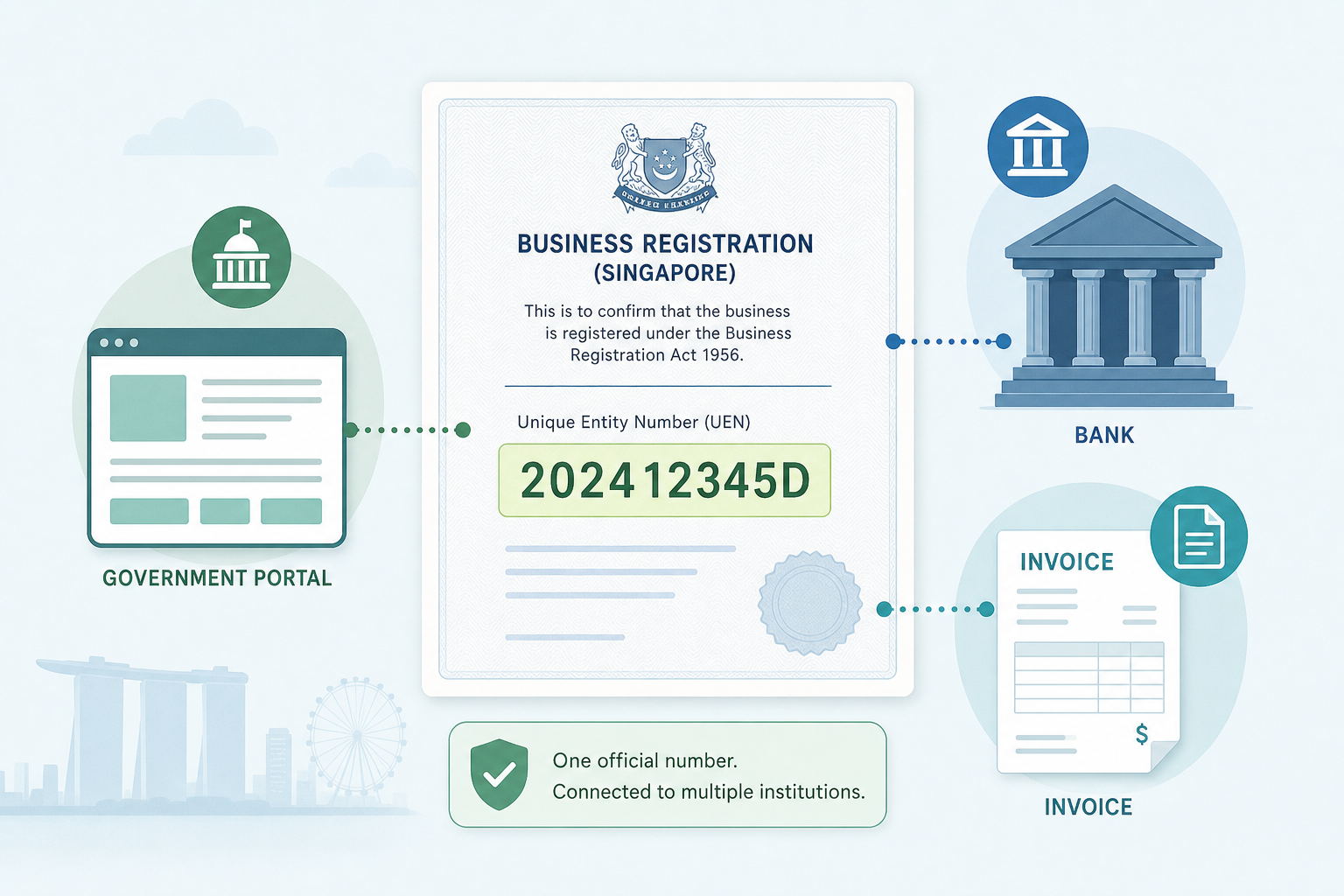
A Unique Entity Number (UEN) is a standard identification number that Singapore's Accounting and Corporate Regulatory Authority (ACRA) issues to every registered business entity, society, and other organisation in the country. Think of it as a national identity card for organisations: a single, permanent reference that government agencies, banks, and counterparties use to identify your business unambiguously across every interaction.
Before the UEN system was introduced, different government agencies each maintained their own entity reference numbers, which meant a single company could carry several different identifiers depending on which agency it was dealing with. The UEN collapsed all of that into one number. Today, any entity registered in Singapore, whether a private limited company, a sole proprietorship, a partnership, a society, or a foreign company branch, receives a UEN as part of its registration.
How the UEN format is structured by entity type
The UEN is not a random string. Its format encodes information about the entity type and, in most cases, the year of registration.
Local companies (private limited companies, public companies) receive a nine-character alphanumeric code. The first four characters are the year of incorporation (for example, 2024), followed by five characters that include letters and digits. A company incorporated in 2024 will have a UEN beginning with "2024".
Sole proprietorships and partnerships registered with ACRA follow a slightly different format, typically starting with a letter rather than a year.
Other entities such as foreign company branches, societies, and statutory boards each have their own defined format, assigned by the relevant issuing agency. The issuing agency is not always ACRA: some entity types are registered through other government bodies, which then issue the UEN on ACRA's behalf.
There is no separate UEN application process
This is the point most founders miss: you do not apply for a UEN separately. The number is assigned automatically the moment your entity is successfully registered. For a Singapore private limited company, that means the UEN is generated as part of the ACRA incorporation filing through the BizFile+ portal.
Once ACRA approves the application, the company receives its ACRA profile, which includes the UEN. The whole process, when documents and KYC are in order, typically completes within one to three business days. If you are incorporating through a corporate services firm, the firm submits the BizFile+ filing on your behalf and the UEN appears on the registration notice that follows.
The practical implication: focus your energy on getting the incorporation right (company name, share structure, constitution, directors) rather than on the UEN itself. The UEN takes care of itself.
Where you are required to display your UEN
Once issued, the UEN is not optional to use. Singapore law requires businesses to display their UEN on all official documents and correspondence. That includes invoices, receipts, letterheads, order forms, delivery notes, and any other document the business issues in the course of trade.
The requirement exists so that counterparties, regulators, and the public can verify the legitimacy of any business they deal with. Failing to display the UEN on business documents is a breach of the Business Names Registration Act or the Companies Act, depending on entity type, and can attract penalties.
Practically, this means your UEN should be set up in your accounting software (such as Xero), your invoice templates, and your email signatures from day one. If you are using a bookkeeping or accounting service, the provider will typically include the UEN in all financial document templates as a matter of course.
How to look up any entity's UEN in Singapore
Your own UEN is printed on your ACRA registration notice and is visible on your company's BizFile+ profile. If you have misplaced it, the ACRA BizFile+ public search tool lets any person look up a registered entity by name and retrieve its UEN, registration status, and basic corporate details at no charge.
This public search function is also how your clients, banks, and government agencies verify your business. A UEN that does not return a result on BizFile+ is a red flag that an entity may not be properly registered. Banks routinely run this check during account opening, and government procurement portals require a valid UEN before a vendor can be onboarded.
For companies that have gone through a name change, the UEN remains the same. The number is permanent and does not change even if the company changes its name, its registered address, or its directors.
A UEN is not something you apply for: it is issued the moment your Singapore entity is registered, and it stays with that entity for life.
How your UEN is issued, step by step
Choose and reserve your company name
Before any registration can proceed, ACRA must approve the proposed company name. The name check and reservation is done through the BizFile+ portal. A name that is approved is reserved for a defined period, giving you time to complete the full incorporation filing. Your corporate services provider can handle this on your behalf if you are incorporating remotely.
Prepare and submit the incorporation filing
The incorporation application requires details including the company's registered address, its directors (at least one must be ordinarily resident in Singapore), its shareholders, share capital structure, and the company constitution. All of this is submitted through BizFile+ as a single filing. Getting these details right at this stage matters, because the information becomes part of the permanent ACRA record and affects everything from nominee director arrangements to future corporate secretarial filings.
ACRA reviews and approves the application
ACRA processes the filing and, if everything is in order, approves the incorporation. Approval typically comes within one to three business days once all documents and KYC requirements are satisfied. For straightforward applications with no name objections or compliance issues, the turnaround is often faster.
Receive your UEN on the registration notice
On approval, ACRA issues a registration notice that includes your company's Unique Entity Number. This is your UEN. It is also visible on your company's public BizFile+ profile immediately after registration. There is no additional step: the UEN is generated as part of the approval itself.
Add your UEN to all business documents
From the moment of registration, your UEN must appear on every official document your company issues: invoices, receipts, letterheads, contracts, and correspondence. Set it up in your accounting and invoicing software and document templates on day one. If you are using a bookkeeping or payroll service, confirm with your provider that the UEN is included in all generated documents.
Benefits
No separate application needed
The UEN is assigned automatically at the point of incorporation or registration, so there is no additional form to file, no waiting period beyond the registration itself, and no fee specific to the UEN.
Permanent and entity-specific
Once issued, the UEN does not change. It stays with the entity regardless of name changes, address changes, or director turnover, making it a reliable long-term identifier for banks, regulators, and counterparties.
Format encodes entity information
For local companies, the UEN's opening four digits are the year of incorporation, so anyone reading the number can immediately see when the company was registered, without needing to look it up.
Publicly verifiable through BizFile+
Any person can search a UEN on the ACRA BizFile+ public portal to confirm registration status and basic corporate details. This transparency supports trust between businesses, banks, and government agencies.
When the UEN becomes practically important
Opening a corporate bank account in Singapore
Every Singapore bank requires a valid UEN as part of the corporate account opening process. The bank will run a BizFile+ search to verify the company's registration status, directors, and shareholders against the UEN before proceeding with KYC. Without a UEN, the account opening cannot proceed. Because the UEN is issued automatically at incorporation, the practical advice is to have your ACRA registration notice ready before approaching any bank.
Issuing invoices to clients or government agencies
A Singapore-registered business that issues invoices without displaying its UEN is in breach of its legal obligations. For companies supplying goods or services to government agencies or large corporates, the UEN is often a mandatory field in procurement and vendor onboarding systems. Any invoice missing the UEN may be rejected outright. Setting up the UEN in Xero or another accounting platform at the point of incorporation avoids this problem entirely.
A foreign founder incorporating remotely
An overseas founder who incorporates a Singapore private limited company through a corporate services firm never needs to interact with ACRA directly. The firm files through BizFile+ on the founder's behalf, and the UEN is issued to the company upon approval. The founder receives the UEN as part of the registration notice, along with the company constitution and ACRA profile, without needing to be physically present in Singapore.
Verifying a supplier or counterparty
Before entering a significant contract, a Singapore business can use the ACRA BizFile+ public search to look up any counterparty's UEN and verify that the entity is legitimately registered, currently active, and has the directors and shareholders it claims to have. This is a standard due-diligence step that takes under a minute and is used by procurement teams, legal counsel, and finance departments alike.
What is a UEN number? Common questions answered
Do I need to apply for a UEN separately after registering my company?
No. The UEN is issued automatically as part of the registration process through ACRA's BizFile+ portal. Once your incorporation application is approved, the UEN appears on your registration notice. There is no separate application, no additional fee, and no waiting period beyond the registration itself.
What does the format of a Singapore UEN tell you?
For local companies, the UEN is a nine-character alphanumeric code whose first four characters are the year of incorporation. Sole proprietorships, partnerships, and other entity types follow different formats, typically starting with a letter. The format is defined by ACRA and encodes the entity type as well as registration year.
Where must a Singapore business display its UEN?
Singapore law requires the UEN to appear on all official business documents, including invoices, receipts, letterheads, order forms, and delivery notes. Failing to display it is a breach of the relevant legislation (the Companies Act or the Business Names Registration Act, depending on entity type) and can result in penalties.
Does a UEN change if the company changes its name or address?
No. The UEN is permanent and does not change even if the company changes its registered name, its registered address, its directors, or its shareholders. It remains the same identifier for the life of the entity.
How can I look up a company's UEN in Singapore?
The ACRA BizFile+ public search tool allows anyone to search for a registered entity by name and retrieve its UEN, registration status, and basic corporate information. Your own UEN is also printed on your ACRA registration notice and visible on your company's BizFile+ profile.