

Singapore businesses can use a fractional CFO partner for senior finance guidance without hiring a full-time CFO. Reported costs range from S$3,000 to S$15,000 per month, depending on the scope of work.
A good partnership should also connect CFO support with bookkeeping, tax, payroll, and compliance, so decisions are based on accurate financial records. Duellix brings these finance services together with fractional CFO support.
Keep reading to compare partnership models, costs, and what to look for in a partner.
Fractional CFO Partnerships in Singapore: Key Takeaways
These points show how businesses can match a fractional CFO partnership to their finance needs and growth stage.
- Connect Finance With Strategy: CFOs can handle forecasting, budgeting, FP&A, and investor reporting. Accounting teams can manage records, reconciliations, payroll, and tax data.
- Match The Model To Your Needs: Advisory, marketplace, modular, full-stack, and embedded models offer different levels of support. Compare scope, pricing, and responsibilities before choosing.
- Look Beyond Referrals: A useful partnership can include client introductions, regular reporting, ongoing finance support, and coordination between the CFO and finance team.
Quick Comparison of Top Fractional CFO Partners in Singapore
The comparison shows that fractional CFO services vary from advisory support to broader finance operations.
| Provider | Model | Key strength | Main limitation | Ideal use case |
|---|---|---|---|---|
| Duellix | CFO + compliance | Accounting, tax, payroll, and compliance in one model | Strategic CFO scope is less detailed publicly | SMEs needing connected finance operations |
| GigLink | Marketplace | Published rates of about US$150–US$350/hour | Advisory rather than embedded operations | Flexible CFO access |
| Growwth Partners | Full-stack | CFO, accounting, compliance, and fundraising | Pricing requires discovery | Growth-stage SMEs |
| Nirji Ventures | Embedded | Investor-focused FP&A and board reporting | S$8,000–S$25,000/month retainer | VC-backed startups |
| FinSphere Global | Specialist | E-commerce finance and unit economics | Narrower general SME fit | DTC and e-commerce brands |
| Fainance | CFO + operations | Singapore and APAC finance experience | Pricing not published | Strategic SME support |
| DFG Advisory | Specialist | Fintech, crypto accounting, and payroll | More specialised than traditional SME finance | Fintech and crypto startups |
| Excellence Singapore | Modular | Tiered CFO support | Entry tier has limited review frequency | Early-stage SMEs |
| Salamander Advisory | Embedded operator | FP&A and board reporting | Pricing not published | Technology startups |
| Qerra Advisory | Strategic CFO | Financial modelling and growth strategy | Limited operational support | SMEs needing strategic finance |
The comparison shows why “fractional CFO” does not describe one fixed service. Some models focus on advice, while others connect senior finance work with bookkeeping, payroll, tax, and reporting.
What Should You Gain By Working With A Strong Fractional CFO Partner?
A fractional CFO partner can connect finance records, reporting, cash flow, and compliance so management can make decisions using current financial data.
1. Get clearer financial visibility
When finance work is split across providers, founders may need to combine bookkeeping, payroll, and tax information before making decisions.
Connected processes give management clearer reports while allowing the CFO to focus on analysis rather than data collection.
A practical setup may include:
- Monthly management reporting
- Cash flow tracking and forecasting
- Budget versus actual analysis
- Documented finance processes
The goal isn’t to produce more reports. It’s to give management financial information that can support decisions.
2. Reduce recurring administrative work
Before using an integrated finance partner, founders may spend hours following up on bookkeeping, payroll, tax documents, and compliance dates. That time can take focus away from sales, hiring, customers, and product work.
Afterward, one team can handle the connected finance tasks. The CFO can focus on forecasts and financial planning while accounting staff handle transactions and reconciliations.
This works best when roles are clear. The CFO shouldn’t need to check every transaction, and the bookkeeping team shouldn’t make major finance decisions without proper guidance.
3. Prepare financial information for investors
Before fundraising, incomplete or inaccurate financial records can create extra work. Investors may ask for management accounts, past financials, forecasts, cash flow records, cap tables, and reasons for changes in results.
With a clear finance process, these records can be maintained as part of normal operations. The CFO can focus on financial models, investor reports, fundraising, and questions about the company’s finances.
For a Singapore startup, this may include ACRA records, tax documents, bank statements, payroll data, and management reports. It’s easier to prepare when these records stay up to date.
The result is a finance process that helps the company prepare before investors ask for a data room.
4. Match support to the business stage
Businesses should avoid paying for senior finance support they do not currently need. An early-stage company may need monthly reports and cash flow support, while a growing company may need board reports, fundraising help, or financial modelling.
The company can then expand the scope as its needs change. A modular setup can cover basic reporting first, while a more involved setup can be added as the finance workload grows.
This approach also helps companies compare a part-time CFO with an in-house finance hire.
5. Build stronger finance operating routines
Without a regular finance routine, reporting may depend too heavily on the founder. Forecasts may only be updated when cash gets tight, and reports may arrive after key decisions are made.
A set reporting schedule makes forecasts, reconciliations, payroll, tax tasks, and management reports easier to manage. Forecasts, reconciliations, payroll data, tax tasks, and management reports can follow the same cycle each month.
A strong partnership should improve finance operations as well as provide strategic advice.
How Did We Build This List Of Fractional CFO Partners For Singapore Businesses?
Provider lists should be treated as comparisons, not definitive rankings. This list uses published service details, public pricing signals, operating models, and stated areas of expertise. Advertising alone isn’t treated as proof of suitability.
1. Clear positioning
First, check whether the provider clearly defines its services.
From a buyer’s view, there’s a difference between a virtual CFO partner program, an accounting provider, a marketplace, and an embedded CFO. A business needs to know whether it’s paying for advice, finance operations, or both.
Clear positioning also makes the first discussion more useful because the business can explain its needs against a defined service model.
2. Coverage of core and advanced needs
A CFO partnership should be assessed against the finance work the company needs.
Core services may include bookkeeping, accounting, payroll, tax, GST, and management reporting. More advanced needs can include FP&A, financial modelling, investor reporting, fundraising readiness, board reporting, or M&A due diligence.
Businesses do not need every service; they need the services that match their current stage.
3. Technology and workflow
Technology matters when finance data moves between accounting, payroll, tax, reporting, and management systems.
Businesses should check which accounting platforms are supported and how information is reviewed. Xero, for example, appears in the published information for several providers, but software certification alone doesn’t show how the wider workflow operates.
Ask how reports are prepared, who checks the numbers, how errors are recorded, and how management gets updates.
4. Fit for different stages
Finance needs vary by business stage, funding status, and industry.
An early-stage company might need cash flow management and monthly reporting. A Series A business might need financial modelling, investor reporting, and board reporting. A company entering several countries may need cross-border finance support.
The partner should fit the company’s current needs without pushing it into a larger service model.
5. Reputation and visibility
Public information can help buyers assess a provider’s experience, credentials, and areas of focus.
That information is one source, not a guarantee. Buyers can also ask about similar finance problems the provider has handled, how the work is managed, and who will handle the account.
For regulated work, businesses should also check the relevant Singapore rules and duties.
6. Transparency of scope and pricing
Pricing varies between hourly support, monthly packages, and retainers. Published pricing includes examples ranging from about S$500 per month for an entry-level modular model to S$8,000-S$25,000 per month for a more embedded startup-focused model.
Price should be compared with hours, deliverables, reporting frequency, seniority, and operational responsibility. A lower monthly price may cover fewer services, while a higher retainer may include more finance work.
7. Response and onboarding
A finance partnership needs a clear process from the start.
Businesses should ask about onboarding time, response times, document collection, accounting system access, handover from the old provider, and who the main contact will be.
This matters when changing providers because old records and open compliance tasks shouldn’t get lost during the change.
Use this list as a guide. Businesses still need to check fit, budget, service scope, and priorities before choosing a fractional CFO partner.
Why Do Businesses Question Whether They Need A Fractional CFO?
Some SMEs question the value of CFO services when they already have bookkeeping. The two roles, however, serve different purposes.
Data from Journal of Business Strategy demonstrates
"Using a fractional CFO or Controller will provide an increased focus on the company's financial health and allow the organization to perform (or oversee) all of the activities that a finance and accounting department should be performing. The scope of work a fractional CFO or Controller performs can be easily modified to meet the needs of the firm. Moreover, they require little direct management. As a result, a fractional CFO or Controller can often be a more cost-effective option than hiring for the finance and accounting function on a full-time basis." - Journal of Business Strategy
A bookkeeper records and organises transactions. A CFO uses that financial information to support forecasting, budgeting, management reporting, fundraising, and decisions about capital.
What Is The Bookkeeper-Versus-CFO Concern?
The two roles can work together.
- Bookkeeping: Records transactions and reconciles accounts.
- Accounting: Prepares financial statements and supports tax needs.
- CFO work: Handles planning, forecasts, reporting, and business decisions.
- Finance operations: Keeps recurring finance systems and processes running.
This explains how a fractional CFO partnership can work. The accounting team can manage the financial records while the CFO focuses on decisions that rely on those records.
That setup may suit an SME that isn’t ready for a full-time CFO but needs more than basic bookkeeping.
Where Does The "Embedded Operator" Concern Come From?
Reddit discussions show interest in embedded operators rather than freelancers. The wider partner discussion also focuses on ongoing relationships instead of basic referrals.
A referral introduces a business to a CFO, but it does not necessarily create an ongoing relationship between the CFO, finance team, and referring partner.
An embedded partnership can go further. The parties can agree on client introductions, regular reviews, reporting duties, and handover steps.
The exact setup will depend on the businesses involved.
How Should Businesses Compare These Fractional CFO Partners?
The list is a starting point. Businesses should compare providers based on their finance needs, operating model, and industry requirements.
Research from WSB Journal of Business and Finance shows
"The study confirms the hypothesis that regular collaboration with an external CFO improves the quality of management reporting, increases tax compliance, and helps SME owners to make investment and strategic decisions based on data." - WSB Journal of Business and Finance
The comparison can come down to five questions:
- What finance work is needed? Forecasting, bookkeeping, tax, payroll, fundraising, or board reporting?
- How much senior support is needed? Occasional advice or an embedded CFO?
- Does the provider handle finance operations? Check if accounting and compliance are included.
- Is pricing clear? Compare the monthly fee with the work covered and reporting schedule.
- Does the provider understand the business? Industry, funding stage, transaction volume, and cross-border needs can affect the right setup.
Duellix combines CFO support with accounting, tax, payroll, and compliance services.
Which Fractional CFO Partners Should Singapore Businesses Consider?
The right partner depends on whether a business needs strategic finance, operational support, specialist expertise, or flexible CFO access.
1. Duellix
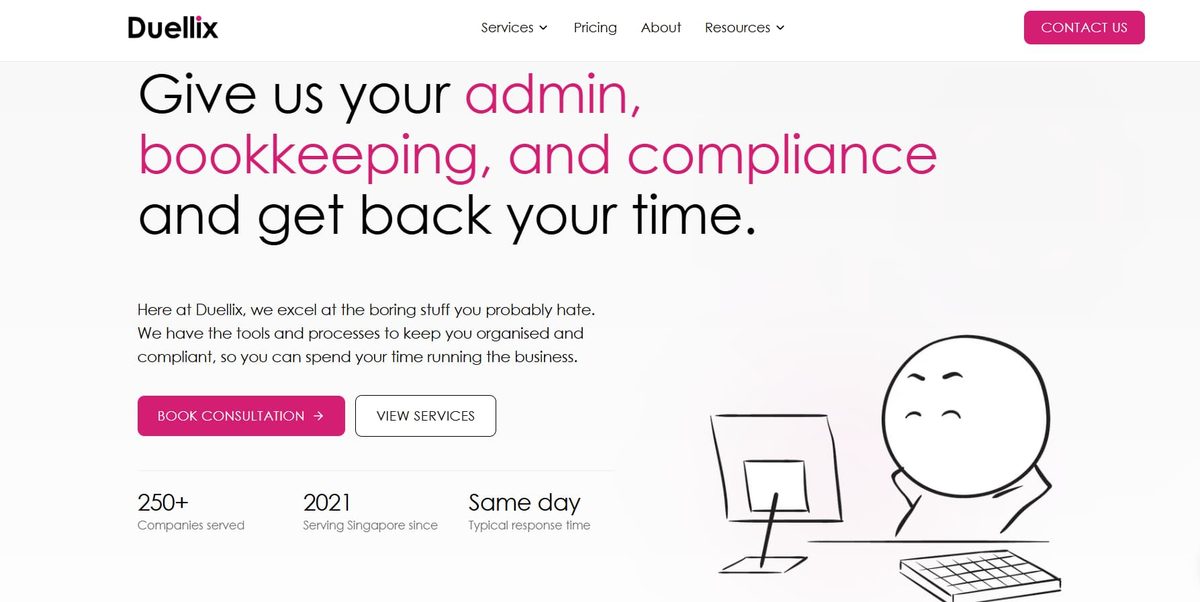
Overview: Duellix combines fractional CFO support with accounting, tax, payroll, and compliance services for Singapore businesses. This model connects CFO work with the financial records used for day-to-day decisions.
Key features:
- Accounting and bookkeeping
- Corporate tax
- GST services
- Payroll
- EOR
- Finance support
- Accounting packages from S$1,400 per year
- Corporate tax compliance from S$450 per year
Strength:
- CFO support can sit alongside accounting, tax, and payroll services, giving businesses one finance partner for related needs.
Weakness:
- Businesses needing specialist fundraising, board strategy, or complex FP&A should confirm the CFO scope before signing up.
Ideal Use Case: Singapore SMEs that need fractional CFO support alongside accounting, tax, payroll, and compliance services.
2. GigLink

Overview: GigLink uses a marketplace model to connect Singapore businesses with credential-verified fractional CFOs. The focus is flexible access to senior finance expertise rather than handling all finance work through one internal team.
Key features:
- Credential-verified fractional CFOs
- Curated CFO shortlists within 48 business hours
- No platform fee for businesses
- Published rates of US$150–US$350 per hour
- Support based on experience and scope
Strength:
- Businesses can compare CFO profiles and select support based on experience, scope, and budget.
Weakness:
- Accounting, payroll, tax, and bookkeeping remain separate unless the chosen CFO also provides those services.
Ideal Use Case: Businesses with existing finance operations that need flexible CFO support for forecasting, fundraising, financial modelling, or specific projects.
3. Growwth Partners
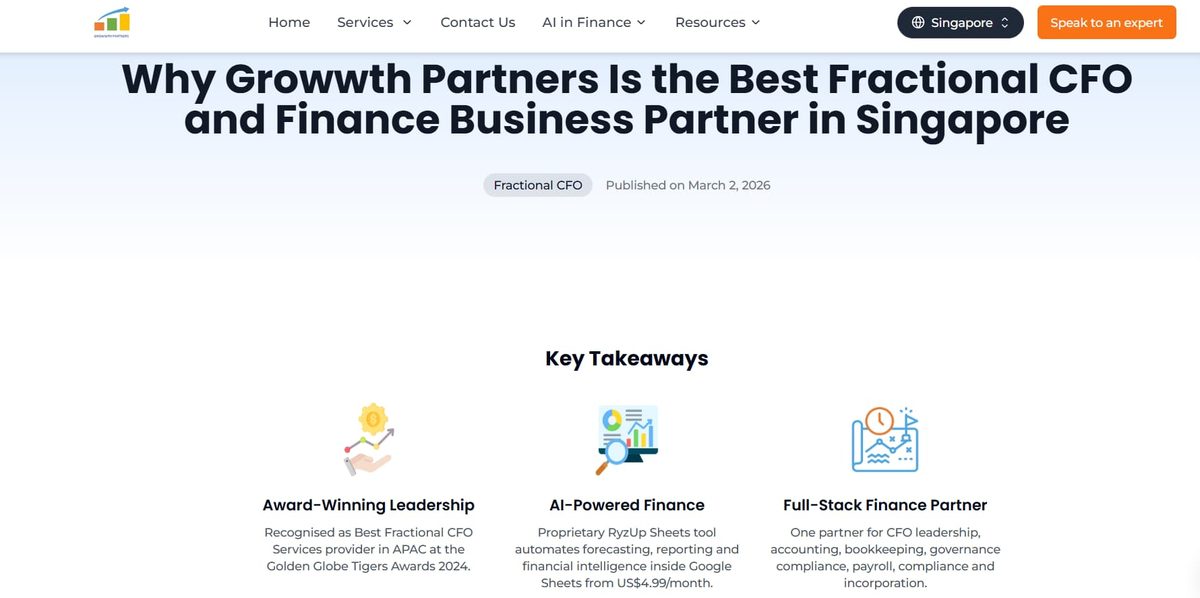
Overview: Growwth Partners provides fractional CFO services alongside accounting, compliance, fundraising, and financial advisory support for startups and SMEs.
Key features:
- Forecasting
- Scenario planning
- Cash flow management
- Capital allocation
- Board reporting
- Investor communication
- Fundraising readiness
- Finance-function oversight
- Experience with more than 500 Xero accounts
- Services across multiple markets
Strength:
- This model suits companies moving beyond founder-led finance.
Weakness:
- Pricing isn’t prominently listed for every CFO engagement, so businesses may need to discuss the scope before comparing costs.
Ideal Use Case: Growth-stage SMEs and startups that need strategic finance, reporting, fundraising support, and stronger finance processes.
4. Nirji Ventures
Overview: Nirji Ventures focuses on fractional CFO and financial advisory services for startups, with an emphasis on investor and growth finance.
Key Features:
- Fundraising support
- Financial planning
- Investor reporting
- Board-level support
- More embedded CFO involvement
Strength:
- A startup-focused model can suit businesses that need finance support tied to fundraising, investor communication, and growth planning.
Weakness:
- Reported pricing of about S$8,000-S$25,000 per month places this model toward the higher end of the comparison.
Ideal Use Case: VC-backed startups and growth companies that need ongoing senior finance support rather than occasional advice.
5. FinSphere Global

Overview: FinSphere Global provides fractional CFO, FP&A, corporate finance, tax advisory, and ERP services. Its public information also covers broader finance and transaction support.
Key Features:
- Financial planning and performance management
- Corporate finance and deal advisory
- Accounting
- Tax advisory
- ERP solutions
- Fractional CFO support
- Xero
- QuickBooks
- Zoho Books
- Odoo
- Power BI
Strength:
- The mix of finance, technology, and transaction support can suit businesses with more complex finance needs.
Weakness:
- Businesses looking only for basic SME bookkeeping and CFO support may not need the wider advisory services.
Ideal Use Case: E-commerce and growth businesses, investors, and companies that need FP&A, transaction support, or technology-based finance services.
6. Fainance
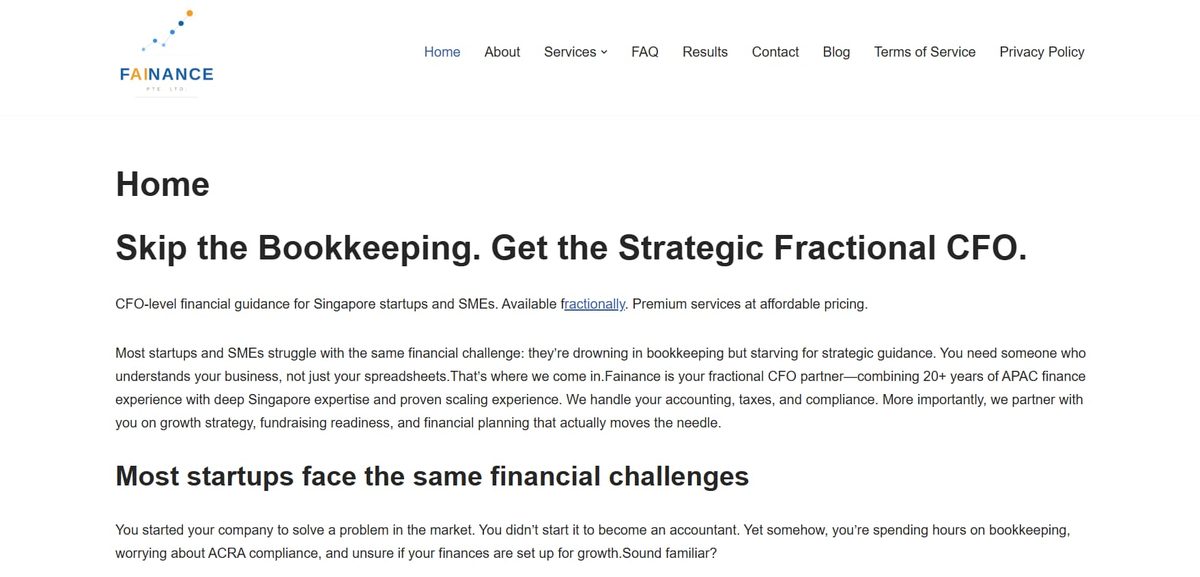
Overview: Fainance provides accounting, tax, compliance, financial planning, and strategic finance support for businesses.
Key Features:
- Accounting
- Tax
- Compliance
- Financial planning
- Fundraising readiness
- Growth strategy
- Finance-process support
- Singapore and APAC experience
Strength:
- The broader model can reduce the need to manage several finance providers.
Weakness:
- Public pricing isn’t clearly stated, so businesses may need to define the scope before comparing costs with fixed-price providers.
Ideal Use Case: SMEs that need both day-to-day finance support and higher-level financial planning.
7. DFG Advisory
Overview: DFG Advisory focuses on fractional CFO services and finance outsourcing for startups, VC-backed companies, fintechs, and high-growth businesses across Singapore and Asia.
Key Features:
- Strategic finance
- Fractional CFO support
- Crypto accounting
- Finance operations outsourcing
- Multi-jurisdiction payroll
- Support from incorporation through IPO
Strength:
- Its specialist coverage can suit fintech companies and businesses operating across several Asian markets.
Weakness:
- Smaller SMEs may not need the full service scope.
Ideal Use Case: Fintech, crypto, VC-backed, and high-growth businesses with complex accounting, payroll, or cross-border finance needs.
8. Excellence Singapore
Overview: Excellence Singapore offers modular fractional CFO support that can be added to its accounting and corporate services. It’s designed for businesses that need extra financial support without a full-time CFO.
Key Features:
- Fractional CFO support from S$500 monthly
- Forecasting
- Reporting
- Cash flow management
- Budgeting
- Decision support
- Finance team supporting 4,000+ businesses
Strength:
- Its modular pricing lets smaller businesses start with limited CFO support and expand as needs grow.
Weakness:
- Lower-priced plans may include less frequent or narrower support than a more embedded CFO arrangement.
Ideal Use Case: Early-stage companies and SMEs that need regular financial visibility but don’t need a full-time CFO.
9. Salamander Advisory

Overview: Salamander Advisory works as an embedded finance partner for technology-focused companies. It’s suited to businesses that need ongoing finance support rather than occasional advice.
Key Features:
- FP&A
- Board reporting
- Investor readiness
- Finance operations
- Embedded finance support
Strength:
- Its embedded approach can give startups more consistent support with reporting and financial planning.
Weakness:
- Public pricing isn’t clearly available, so direct cost comparisons may be harder.
Ideal Use Case: Technology startups that need regular FP&A, investor reporting, and finance management support.
10. Qerra Advisory

Overview: Qerra Advisory focuses on strategic CFO support, with services covering financial modelling, capital raising, and growth planning. It’s suited to businesses that already have core accounting handled.
Key Features:
- Financial modelling
- Capital raising
- Growth strategy
- Strategic CFO support
- Packages from about S$700-S$1,500+ monthly
Strength:
- Its strategy-focused model can suit companies that already have bookkeeping and compliance covered.
Weakness:
- Its lighter operational coverage means some businesses may need separate finance support.
Ideal Use Case: SMEs and startups that need financial modelling, capital planning, fundraising support, or growth strategy.
What Does Fractional CFO Partner-Program Economics Look Like?
Partner programs can involve referrals, portfolio relationships, preferred pricing, discounts, minimum engagement requirements, or recurring commercial arrangements.
The commercial terms should be clear to both sides. A referral partnership isn’t the same as a finance delivery partnership.
What does the 512 Financial example show?
One example is the 512 Financial Partner Program, a structured relationship between a finance provider and partner organisations.
The reported features include:
- 15% referral discount
- Portfolio-wide visibility for venture firms
- 10-hours-per-week minimum
- $12,000-$15,000 monthly retainers
These figures are examples of one partner model, not a standard Singapore market rate.
The broader point is that a CFO partnership can extend beyond the first introduction. A VC, accelerator, consultant, law firm, bank, or corporate services provider may continue working with the CFO partner when its portfolio or clients need finance support.
Why does pricing structure matter?
Pricing affects how a partner manages the client relationship and delivery model.
A referral arrangement may use a one-time fee or discount. A deeper partnership may include recurring revenue, portfolio pricing, shared support, or agreed service packages.
Define the commercial terms before client introductions begin. A written partnership MSA can cover responsibilities, referral handling, confidentiality, commercial terms, and termination conditions.
Where Are Singapore Fractional CFO Partner Programs Actually Discussed?
Public discussion of Singapore fractional CFO partner programs appears limited. More information appears through provider websites, LinkedIn, direct sales conversations, and investor networks.
Limited public discussion does not mean these programs are uncommon; many B2B arrangements are discussed privately.
What did niche forums show?
Our searches found no recent matching discussions about fractional CFO partner programs across several Singapore and regional forums.
- No matching Lowyat threads
- No relevant HardwareZone discussions
- Seedly results focused on consumer finance
- No relevant Tech in Asia forum discussions
Forum activity should not be used to judge provider quality.
Why might public discussion remain limited?
Fractional CFO partnerships are mainly B2B relationships involving companies, investors, accelerators, professional service firms, and finance providers.
Commercial details may also stay private. Referral percentages, client introduction processes, partner discounts, minimum engagement levels, and portfolio arrangements are often discussed directly rather than posted publicly.
This helps explain why a business searching for a Singapore CFO partner ecosystem may find more information through professional networks than consumer forums.
What Should You Check Before Joining Or Selecting A Partner Program?
The evaluation should start with the finance problem, then move to service scope, operating model, cost, and practical fit.
Before selecting a partner, businesses can compare these areas:
- Business Stage: Does it fit the company’s stage?
- Finance Needs: What finance work is needed?
- Operating Model: Advisory, marketplace, modular, or embedded?
- Cost: Rates, packages, retainers, and extra charges
- Response: Onboarding time and communication expectations
- Specialisation: Relevant industry or finance experience
- Operational Coverage: Accounting, payroll, tax, and compliance
Compare providers by the work they will handle, not just the service title.
FAQ
What should I look for in a fractional CFO partner program in Singapore?
Look for clear services, defined partner responsibilities, referral terms, and client support. A suitable program should explain whether partners provide strategic finance support, financial planning, cash flow management, or investor reporting.
Before joining, check how client introductions work, how referral fees are handled, who manages the client relationship, and what support partners receive.
When does a CFO as a Service partner make sense for my business?
A CFO as a Service partner can help when your business needs senior finance support without hiring a full-time CFO. A part-time CFO partnership may cover cash flow management, FP&A, investor reporting, or financial planning.
This model can also suit growing companies that need a growth-stage CFO partner as their reporting and financial planning needs become more complex.
How can I find the right Singapore CFO partner ecosystem for my company?
Start by identifying the finance functions your company needs and the type of clients you serve. An outsourced CFO partner network may include accounting advisory, payroll, taxation compliance, and fundraising readiness partners.
A startup CFO partner can also support financial modelling, runway discipline, management reporting, and Series A readiness when a growing company needs more structured financial support.
What should I ask before joining a virtual CFO partner program?
Ask how the CFO partner onboarding process works, how client introductions are handled, and how referral flow management is tracked. You should also review the partnership MSA, commercial terms, renewal conditions, and exit requirements.
If the program uses a monthly retainer CFO model, confirm the notice period and understand how client relationships are managed after a referral.
Can a finance partner support my business beyond basic accounting?
Yes. A finance leadership partner can support financial planning, cash flow management, management reporting, financial modelling, and board-grade reporting.
Depending on your business needs, a board advisory partner can also support governance and investor communication. A finance transformation partner can help improve reporting processes, financial controls, and finance operations as your company grows.
What Is The Next Step For Finding A Suitable Fractional CFO Partner?
A fractional CFO can be a good fit when your finance needs have moved beyond basic bookkeeping, but a full-time CFO doesn't make sense yet. The right partner should match your business stage, workload, reporting needs, and budget.
Before agreeing to a retainer or referral arrangement, compare each partner’s scope, pricing, and responsibilities. If you're looking for a finance partner that brings accounting, compliance, and fractional CFO support together, explore Duellix's fractional CFO partner program in Singapore.
References
- https://www.emerald.com/jbs/article-abstract/44/4/211/202321/A-fraction-of-an-executive-new-ways-to-save-and
- https://econpapers.repec.org/article/vrswsbjbf/v_3a60_3ay_3a2026_3ai_3a1_3ap_3a50-59_3an_3a1008.htm