

Singapore has more than 1,800 fintech firms, and many need accounting support from providers familiar with financial services, tax, and local regulations. The right firm depends on your startup's size, transaction volume, compliance needs, and budget.
Some focus on daily accounting and payroll, while others offer audit and advisory services for growing businesses. This guide compares 10 accounting firms, starting with Duellix, to help you find a suitable partner.
Read on to compare their services and areas of focus.
Fintech Accounting: What Singapore Founders Should Know
Choosing the right accounting partner comes down to your fintech startup's stage, regulatory obligations, and financial reporting needs. Here are the providers worth considering for different business requirements.
- Best for early-stage fintech operations: Duellix handles accounting, tax, payroll, company incorporation, and corporate services through one local partner.
- Best for specialist audit requirements: GYK provides statutory and internal audits, including audits related to Monetary Authority of Singapore (MAS) compliance.
- Best for scaling fintech groups: BoardRoom, BDO Singapore, and Deloitte Singapore offer accounting, reporting, and advisory services for businesses with more complex needs.
Which Accounting Firms Are Worth Comparing?
Each firm offers a different mix of services. Some focus on daily accounts and tax, while others handle audits and support for larger businesses.
Here is a quick comparison of 10 accounting firms in Singapore.
| # | Accounting firm | Main services | Key strength | Potential limitation | Ideal use case |
|---|---|---|---|---|---|
| 1 | Duellix | Accounting, tax, payroll, incorporation, corporate services | Published pricing and named account manager | Not a specialist audit or MAS advisory firm | Early-stage fintechs |
| 2 | Osome | Digital accounting, tax, incorporation, secretarial | Automated workflows and startup packages | Less suited to complex regulated-finance audits | Digital-first startups |
| 3 | Sleek | Accounting, tax, payroll, corporate services | Bundled plans and founder-friendly onboarding | Some services require add-ons | Startups seeking outsourced finance |
| 4 | Counto | Bookkeeping, tax filing, bank connections | Pricing suited to high transaction volumes | Payroll costs extra; less regulatory focus | Transaction-heavy fintechs |
| 5 | BoardRoom | Accounting, consolidation, financial reporting | Multi-entity reporting capabilities | Higher entry pricing | Regional fintech groups |
| 6 | 3E Accounting | Incorporation, accounting, tax, payroll, secretarial | Broad service coverage | Less fintech-specific regulatory specialisation | New Singapore entities |
| 7 | SG Accountants | Accounting, advisory, forecasting, ERP support | Financial strategy and sector familiarity | Bespoke pricing may apply | Funded fintechs |
| 8 | GYK | Audit, accounting, tax, advisory | Payment Services Act audit experience | Capacity may vary for large engagements | Licensed payment firms |
| 9 | BDO Singapore | Audit, assurance, tax, advisory | Audit and growing-company support | Less startup-platform-oriented | Growth-stage fintechs |
| 10 | Deloitte Singapore | Audit, tax, risk, consulting | Regulatory and cross-border expertise | Premium, quote-based pricing | Complex international fintechs |
What You Gain by Working With a Strong Accounting Partner
Fintech founders have a lot to manage. Payment records, tax deadlines, and financial reports all need attention.
A suitable accounting partner can take care of these tasks. This gives founders more time to focus on their products and customers.
1. How can better financial reporting support fundraising?
Investors want to know how a company handles its money. They may ask about sales, expenses, cash flow, and spending.
Regular management accounts help founders answer these questions.
As noted by Penningtons Manches Cooper:
"Investors will scrutinise closely during diligence", particularly around tax compliance and other financial fundamentals, and "Toby Hermitage, tax partner at Gravita, urged founders to approach diligence proactively." - Penningtons Manches Cooper
Without clear records, preparing for investor checks can take longer. The team may need to find old transactions or fix missing entries. Up-to-date reports make this work easier.
2. How does organised bookkeeping improve daily operations?
A fintech may process thousands of payments each month. Keeping track of them in separate spreadsheets can get difficult.
A payment startup, for example, may use several banks and payment gateways. Its accounting team needs to match these records and check for errors.
Regular bookkeeping covers:
- Organising transaction records.
- Matching bank statements.
- Sorting business expenses.
- Preparing monthly accounts.
- Recording corrections and unusual transactions.
These tasks help founders see where their money goes.
3. How can professional tax support prevent filing problems?
Fintech companies may have different tax duties based on their services and income.
An accounting provider can help with corporate tax, Goods and Services Tax (GST) registration, and filing dates.
Singapore's standard GST rate is 9%. Businesses generally need to register when taxable turnover exceeds S$1 million in a calendar year. Some may also need to register based on turnover expected in the next 12 months.
Financial services can have different GST rules. Some are exempt, while others are taxable. The type of service matters.
4. Why does having one accountable contact matter?
A named account manager gives founders one main person to contact about their accounts.
For example, a founder may have questions about Central Provident Fund (CPF) contributions, tax papers, or filing dates. A regular contact can direct the request and explain what happens next.
Before signing an agreement, ask who will manage your account and who will help when that person is away.
5. How can the right partner support business expansion?
Expanding into other countries means more accounts and tax rules to manage.
A fintech company in Singapore, Malaysia, and Indonesia may have separate companies, bank accounts, and tax duties.
Some accounting firms can manage accounts for several companies and prepare group reports. Others may work with local partners.
Ask whether regional accounting and tax support are included in the fee.
How We Built This List of Accounting Firms for Fintech Startups
We compared publicly available company information, listed services, and common fintech accounting needs.
Here are the points we considered.
1. Clear positioning
We checked whether each firm explains its accounting, audit, tax, and corporate services.
A clear service list helps founders understand what they are paying for. It also shows when they may need another provider.
2. Coverage of core and advanced needs
We looked at services such as:
- Bookkeeping and financial statements.
- Corporate tax and GST.
- Payroll services.
- Statutory audits.
- Regulatory audit support.
A small fintech may need basic accounting help. A licensed payment company may also need specialist audit services.
3. Technology and workflow
We considered digital accounting tools, bank connections, Xero integration, and automated bookkeeping.
These tools can reduce manual work and help organise financial records.
Founders should still ask how the firm checks transactions, fixes errors, and prepares reports.
4. Fit for different startup stages
We considered whether firms can support new startups, funded companies, licensed payment firms, and international groups.
A new company may need help with incorporation and bookkeeping. A growing fintech may need more detailed reports and audit support.
5. Reputation and industry experience
We reviewed public company information and relevant industry references.
Singapore has more than 1,800 fintech firms, but this does not mean every accounting provider has fintech experience.
Founders should ask about similar clients, staff qualifications, and past work.
6. Transparency of scope and pricing
We considered published prices, service packages, and extra fees.
Before signing, ask for a written breakdown of:
- Monthly accounting fees.
- Tax filing charges.
- Payroll costs.
- Annual filing fees.
- Extra charges for additional work.
This helps you understand the full cost.
7. Regulatory and technical capabilities
We looked at experience with Accounting and Corporate Regulatory Authority (ACRA) filings, MAS-related audits, and financial reporting.
Bookkeeping and independent audits are different services. Founders should check whether their provider can perform the required audit or needs to work with another qualified firm.
1. Duellix
Overview
Duellix handles several business tasks for companies in Singapore. Its services cover accounting, tax, payroll, company setup, and admin support. For fintech founders, this means one provider can take care of many routine tasks as the business gets started and grows.
Key features:
- Bookkeeping and management accounts
- Financial statements and Inland Revenue Authority of Singapore (IRAS) tax filing
- GST services
- Payroll and CPF administration
- Employer of Record (EOR) and visa services
- Company secretary services
Strengths:
- Prices are published
- Each client has a named account manager
- Several business services are available in one place
- Support covers different stages of running a company
Weaknesses:
- Statutory audits are not its main focus
- It is not presented as a specialist MAS regulatory adviser
Ideal use case: A new fintech company that wants help with its accounts, tax, payroll, and company setup.
2. Osome
Overview
Osome offers online accounting and company services for startups and small businesses. Founders can use its digital tools to manage their books and handle routine company paperwork. Much of the process takes place online.
Key features:
- Automated bookkeeping
- Tax services
- Company incorporation
- Corporate secretarial services
- App-based workflows
Strengths:
- Online tools make routine tasks easier to manage
- Offers packages for startups
- Accounting and company admin services are brought together
Weaknesses:
- Complex audits for regulated finance businesses may fall outside its standard services
- Specialist advice may need to be arranged separately
Ideal use case: A fintech startup that prefers online accounting and has fairly standard accounting and filing needs in Singapore.
3. Sleek

Overview
Sleek combines accounting with company admin services. Its support includes bookkeeping, payroll, annual filings, and links with accounting software. Founders can choose a service plan based on the work they need done.
Key features:
- Bookkeeping and accounting
- Annual company filings
- Payroll services
- Xero integration
- GST services, depending on the plan
Strengths:
- Several services can be bundled into one plan
- Online onboarding
- Support from a named accountant
Weaknesses:
- GST and some extra services may come with added fees
- Not every plan will suit every business, so check the transaction limits and reporting options before signing up
Ideal use case: A founder who wants regular accounting help and a digital way to manage everyday company tasks.
4. Counto
Overview
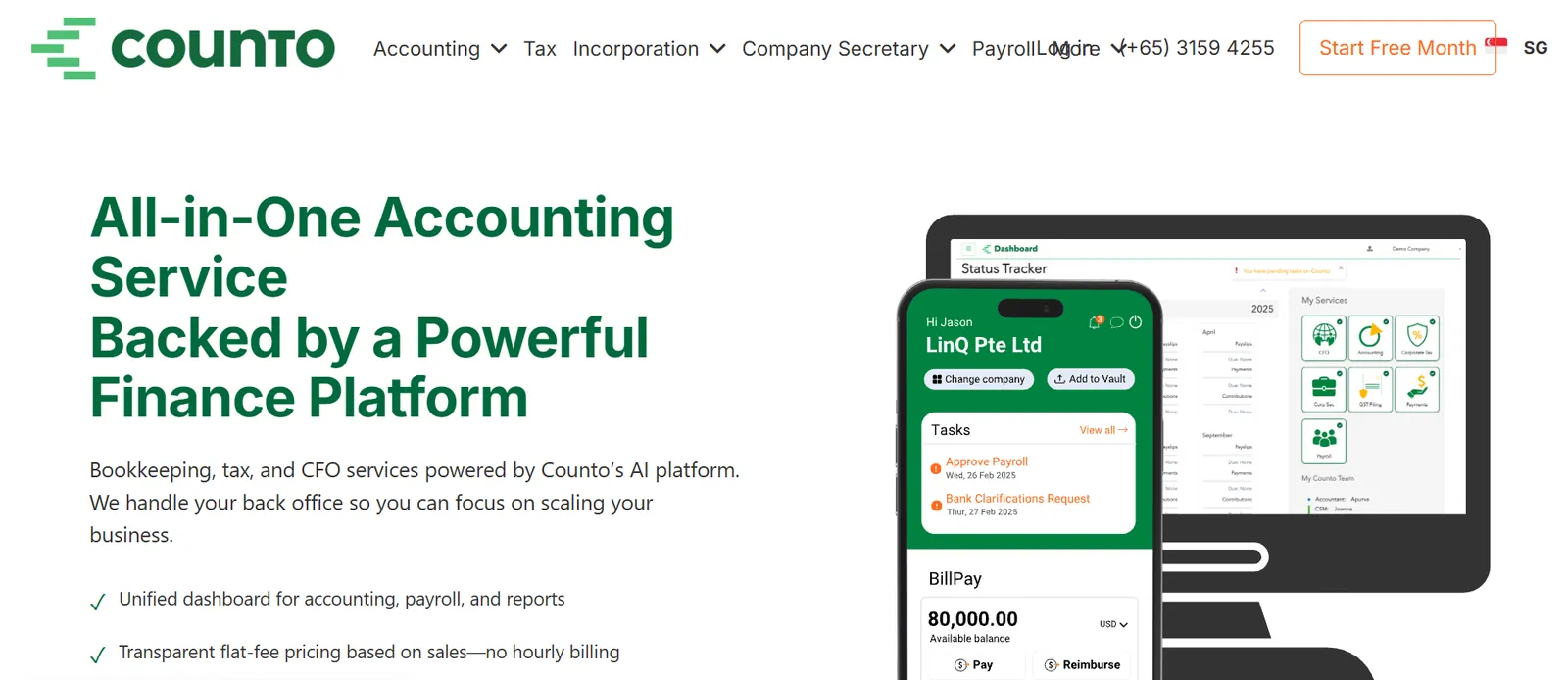
Counto offers accounting services supported by technology. It handles bookkeeping, tax filing, and bank connections. Its services may be useful to fintech startups that deal with a large number of payments and transactions.
Key features:
- Bookkeeping
- Tax filing
- Bank connections
- Support for high transaction volumes
Strengths:
- Flat-price options for businesses with many transactions
- Workflows designed to manage larger volumes of activity
Weaknesses:
- Payroll may be charged separately
- Its standard accounting service should not be treated as specialist fintech regulatory support
Ideal use case: A payment or transaction-heavy startup that needs to keep its growing number of transactions in order.
5. BoardRoom

Overview
BoardRoom provides accounting and corporate services for businesses with more involved reporting needs. For example, it can help prepare financial statements and combine figures from several companies into group reports.
Key features:
- General ledger services
- Financial statements
- XBRL reporting
- Group consolidation
- Xero and SAP support
Strengths:
- Can support reporting across several companies
- Handles more complex company structures
- Offers accounting and corporate services under one provider
Weaknesses:
- Starting fees may be higher than those of firms serving smaller startups
- Costs and services can vary with the company structure, so ask for a clear breakdown
Ideal use case: A fintech group with several companies or regional operations that needs its financial reports to follow a consistent format.
6. 3E Accounting

Overview
3E Accounting helps businesses set up and run companies in Singapore. Its services cover company registration, accounting, tax, payroll, and other admin work. This gives new founders one place to ask about several setup and compliance tasks.
Key features:
- Company incorporation
- Accounting and bookkeeping
- Corporate tax and GST
- Payroll
- Corporate secretarial services
- Immigration support
Strengths:
- Covers a wide range of company services
- Works with new Singapore companies
- Several admin tasks can be handled by one provider
Weaknesses:
- A wide service range does not necessarily mean specialist knowledge of fintech rules
- Founders should ask about its experience with their type of payment or financial service
Ideal use case: A new fintech business that needs help with company setup, accounts, tax, and routine filings.
7. SG Accountants

Overview
SG Accountants offers more than day-to-day accounting. Its services also include financial planning, business forecasts, transaction advice, and ERP support. These may be useful as a fintech company grows and its finance needs become more involved.
Key features:
- Accounting and compliance
- Financial forecasting
- Transaction advisory
- ERP support
- Finance support for growing businesses
Strengths:
- Offers business advice as well as routine accounting
- May suit companies with more developed finance needs
- Its company information states that it has experience with financial institutions and fintech businesses
Weaknesses:
- Extra advisory work may need a separate quote
- Founders should ask which services are available and what the work includes
Ideal use case: A funded fintech startup that needs help with financial planning and business decisions, as well as bookkeeping and compliance.
8. GYK

Overview
GYK offers audit, accounting, tax, and advisory services. Its work includes statutory audits, internal audits, and audits linked to MAS requirements. This makes it worth considering for payment firms that have regulatory duties.
Key features:
- Statutory audit
- MAS compliance audit
- Internal audit
- Accounting
- Tax services
Strengths:
- Offers audit services for regulated payment businesses
- Its service information refers to experience with Payment Services Act licensing audits
- Provides both audit and accounting services
Weaknesses:
- Founders should check whether the firm can handle the size and needs of their business
- Audit work needs its own scope and fee agreement. It should not be assumed to come with routine bookkeeping or tax services
Ideal use case: A licensed payment firm that needs audit work linked to its regulatory duties.
9. BDO Singapore
Overview
BDO Singapore belongs to an international network of professional services firms. It offers audit, tax, and business advice. These services may help fintech companies as they grow, raise funds, or face more detailed reporting needs.
Key features:
- Audit
- Assurance
- Tax advisory
- Business advisory
Strengths:
- Provides audit and assurance services
- Works with growing businesses
- Has links to an international network
Weaknesses:
- Its services may be less focused on the online accounting tools often used by small startups
- Founders should check that the proposed work and fees fit their stage of growth
Ideal use case: A growing fintech company preparing for an audit, raising funds, or dealing with more complex financial reports.
10. Deloitte Singapore
Overview
Deloitte Singapore works across audit, tax, risk, technology, and business consulting. Its wide range of services may suit fintech companies with complex operations or plans to work in more than one country.
Key features:
- Audit and assurance
- Tax advisory
- Risk management
- Technology transformation
- Business consulting
Strengths:
- Covers several areas of professional services
- Can support businesses with cross-border needs
- Offers services related to risk, regulation, and technology
Weaknesses:
- Fees are usually set through a custom quote
- The full range of services may be more than a small startup needs
Ideal use case: A fintech company with complex operations, regulatory needs, or plans to expand into other countries.
What Accounting Requirements Should Fintech Founders Check Before Hiring?
Fintech accounting can involve more than daily bookkeeping. Payment services, licences, and overseas transactions may bring extra duties.
Check these areas before choosing a provider.
Does your provider understand MAS licensing requirements?
Singapore's Payment Services Act covers specific payment services. The licence a company needs depends on its activities and the rules that apply.
For example, MAS uses monthly transaction thresholds of S$3 million for one payment service and S$6 million for two or more payment services when assessing relevant Standard Payment Institution and Major Payment Institution requirements. Different rules apply to e-money.
Ask whether your accounting provider can work with your compliance team and prepare the financial records needed for regulatory reports.
Can the provider support statutory and regulatory audits?
Bookkeeping and external audits are different services. Your accounting provider may manage monthly records, while an independent auditor checks the company's financial statements.
MAS also sets annual audit requirements for relevant Payment Services Act licensees.
Before hiring a firm, ask:
- Which audits does your company need?
- Who will carry them out?
- Are audit fees included?
- Can the accounting firm work with an independent auditor?
Do not assume that a monthly accounting package covers every audit requirement.
Can it handle high-volume payment reconciliation?
A payment company may use several banks, wallets, and payment gateways.
Its accounting provider needs a clear way to record payments and check for differences.
Ask how the firm handles:
- Individual transaction records.
- Bank and payment gateway reconciliation.
- Settlement date differences.
- Refunds and chargebacks.
- Missing or duplicate transactions.
Ask the provider to explain its process, not only its software.
Does it support multi-currency and regional reporting?
A fintech operating across ASEAN may receive and send money in several currencies.
This can make financial reports harder to manage.
Ask which accounting systems the firm supports, how it records foreign currency transactions, and whether it can prepare reports for several companies.
If you need group reports, check whether this service is included in the agreement.
Can it explain Singapore tax obligations?
Founders need to understand their GST registration status, corporate tax duties, and filing dates.
Singapore's standard GST rate is 9%. Compulsory registration generally applies when taxable turnover exceeds S$1 million under the retrospective or prospective tests.
Financial services do not all have the same GST treatment. Ask the provider to review your income and explain which rules apply.
Why Is Fintech Accounting Different From Ordinary Startup Accounting?
A fintech may handle more than normal sales and expenses. Payment records, customer funds, licences, and foreign currencies can add extra work.
As highlighted by Shir Li Ng:
"As financial transactions increasingly migrate to technology-driven platforms, there arises a pressing need to reconcile traditional accounting standards with the new innovative practices brought forth by fintech solutions." - IGI Global
| Accounting consideration | Ordinary startup | Regulated fintech |
|---|---|---|
| Bookkeeping | Income and expenses | Individual transactions and payment checks |
| Cash management | Business bank balances | Possible customer-money safeguarding duties |
| Reporting | Management accounts | Extra regulatory reports where required |
| Audit | Based on statutory rules | Extra MAS audit duties where applicable |
| Tax | Corporate tax and GST | Corporate tax, GST, and activity-specific rules |
| Technology | Standard accounting software | May need payment and ledger integrations |
These differences matter when choosing an accounting firm. Make sure the provider understands your business and the rules that apply to it.
The founder must still check that all required duties are covered.
What Questions Should You Ask Before Signing an Accounting Agreement?
A short meeting can help you see whether a firm's services match your needs.
Ask these questions before agreeing to a monthly fee:
- Who will manage our account?
- Who takes over when that person is away?
- Which services are included in the monthly fee?
- Are GST filing, payroll, and CPF administration included?
- How often will we receive financial reports?
- Which accounting platforms and payment gateways do you support?
- Can you work with an independent audit firm?
- What extra fees apply when transaction volumes increase?
- How do you protect our financial records and documents?
- Have you worked with fintech companies with similar needs?
Ask for written answers. Your agreement should explain the work, deadlines, fees, and any services that cost extra.
Common Fintech Accounting Pitfalls to Avoid
A low monthly fee may not cover every service. Check the full agreement before choosing a provider.
Treating all payment income as the same type of revenue: Transaction fees, subscriptions, and interest may have different accounting and GST rules. Ask how each type will be recorded.
Assuming bookkeeping covers regulatory compliance: Monthly accounts do not replace licensing advice or independent audits where required. Make sure each task has a clear owner.
Relying on vague automation claims: Ask which tasks the software handles and which still need human checks.
Overlooking additional fees: GST filing, payroll, and complex payment checks may cost extra. Ask for a full fee list before signing.
Waiting until fundraising to organise records: Missing payments and unclear reports can slow down investor checks. Keep your financial records up to date throughout the year.
FAQ
How can you check whether an accounting firm protects your financial data?
Before sharing financial data, ask how the firm stores it, who can access it, and how it protects files during transfer. Check whether it holds ISO 27001 or SOC 2 Type II (also called SOC 2 Type 2) security certifications. Ask about data-processing agreements, backups, fraud and phishing protection, and its process for reporting a security breach promptly in writing.
Can an accounting firm connect with your payment systems?
Ask whether the accounting team can connect its system to your payment gateway, business bank account, and other financial networks. These links can reduce manual work when recording digital payments, credit card transactions, payment processing fees, and subscription billing. Confirm how the team records refunds, failed payments, and foreign exchange fees, including any FX markup, before you sign the agreement.
How can artificial intelligence improve fintech accounting?
Artificial intelligence and machine learning can help classify financial data, flag unusual transactions, and automate routine tasks. Ask which steps use workflow automation and which require staff review. Find out how the firm checks errors, protects customer information, and shares real-time insights. Choose a clear process with named responsibilities rather than relying on broad claims about AI in daily work.
What accounting support do fintech companies need when hiring overseas?
If your fintech hires staff overseas, ask whether the provider can support each legal entity and local employment contract. Confirm whether its services include payroll, employee HR support, cross-border immigration, and team management.
Ask which countries it covers, who checks local employment rules, and whether Global Entity & Employment Operations are included in the fee or billed separately in writing.
What financial reports should a fintech company prepare for investors?
Investors may ask for reports that explain revenue, costs, cash flow, risk exposure, and capital allocation. Depending on your business, they may also need details about borrower engagement, loan decisions, or investment performance.
Ask whether the firm can prepare these reports, explain the figures, and deliver them on an agreed schedule before the funding round begins.
Final Thoughts: Choosing the Right Accounting Firm for Your Fintech
Choosing an accounting firm takes more than comparing service lists. You need a provider that understands your fintech business and can support its current needs. The wrong fit can lead to extra costs and more work for your team.
If you're an early-stage founder looking for one local partner to handle accounting and business administration, Duellix is worth considering. Its services can help reduce the time you spend on routine admin work.
To find the right support for your business, contact Duellix about accounting services for fintech startups in Singapore and discuss what your company needs.
References
- Ng, Shir Li. "Striking the Balance: Accounting Regulatory Compliance and Standards in Fintech." IGI Global Scientific Publishing, 2024. Accessed November 16, 2026.
- Carling, Adam; Hill, Charlotte; Gangji, Anoushka; and MacPherson, Kristina. "Scale with Confidence: Key Insights from Penningtons Manches Cooper's Fintech Roundtable." Penningtons Manches Cooper, June 22, 2026. Accessed November 16, 2026.