
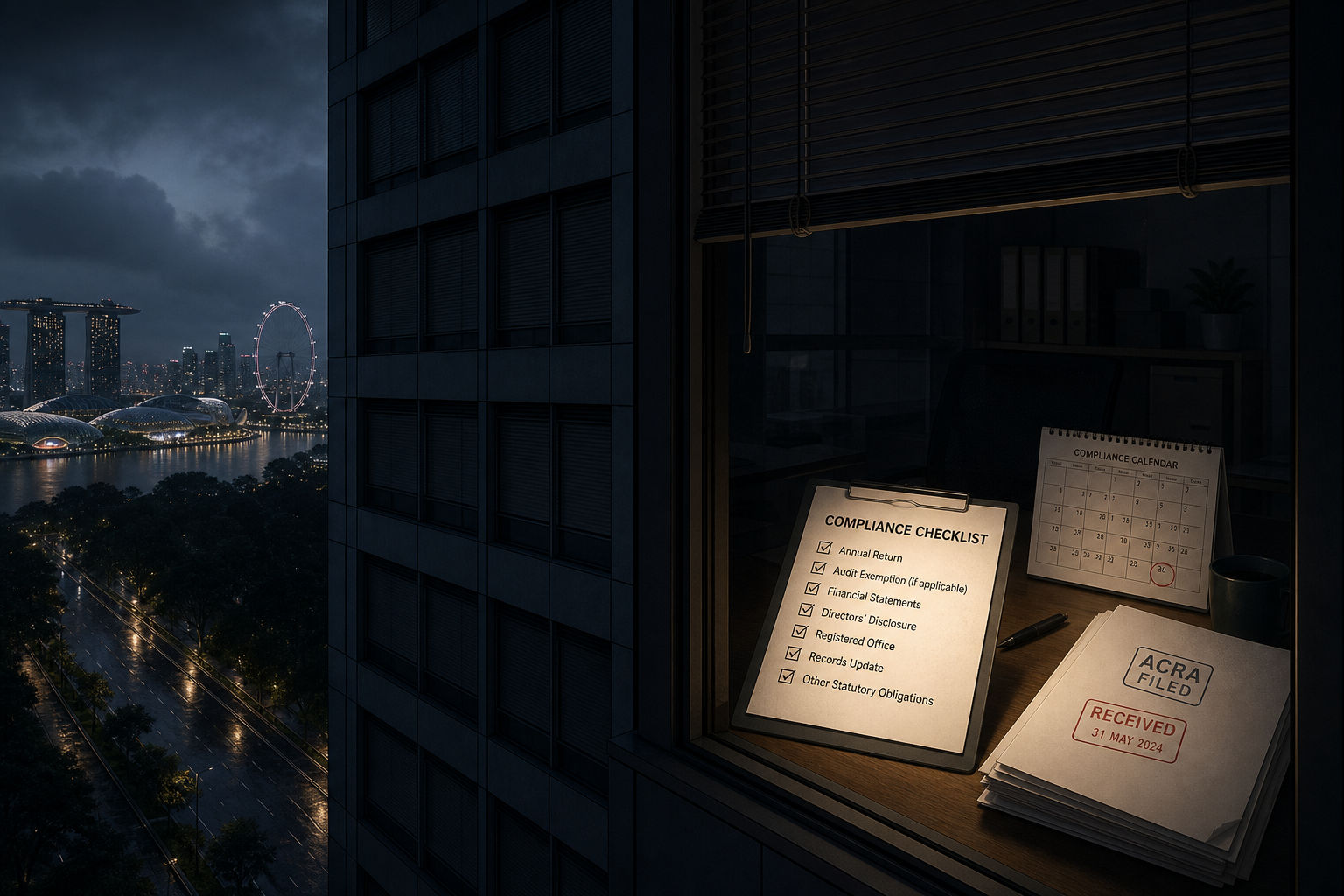
What makes a company dormant under Singapore law
A company is considered dormant when it has had no accounting transactions during a financial year. That is the operative definition under the Companies Act: not whether the company is trading, not whether it has employees, but whether any entry has been made in its books. A company can hold assets, own intellectual property, or sit as a holding vehicle and still qualify as dormant, provided no financial transaction has occurred in the period.
The company remains fully incorporated and registered with ACRA throughout. Its UEN number stays active, its legal personality is intact, and its directors remain in office with all the duties that come with that role. Dormancy is a financial status, not a legal one. That distinction matters enormously when it comes to what you still have to do.
Annual returns and ACRA filings still apply
The most common misconception about dormant companies is that they can simply be left alone. They cannot. Every Singapore-incorporated company, dormant or not, must file an annual return with ACRA through BizFile+. The annual return confirms the company's registered particulars: its officers, registered address, share capital, and financial year end. Missing the filing deadline exposes the company and its directors to penalties.
For dormant companies that qualify as small companies (broadly, those meeting the size thresholds under the Companies Act), there is an exemption from the requirement to prepare audited financial statements. Instead, unaudited accounts may suffice. But the annual return itself is not optional. The registrar of companies has the power to strike a company off the register for persistent non-compliance, and that outcome can be difficult and costly to reverse.
AGMs, accounts, and the small company exemption
Private companies in Singapore are generally exempt from holding Annual General Meetings if they send their financial statements to shareholders within the required period. Dormant companies can benefit from this exemption, but they must still prepare and circulate financial statements unless they qualify for a further exemption available to dormant companies that have never had accounting transactions since incorporation or have passed a members' resolution to dispense with accounts.
Even where a full set of accounts is not required, the company must be able to demonstrate its dormant status. Directors should keep records showing that no transactions occurred. If a single transaction slips through, the company loses its dormant status for that financial year and the full suite of obligations applies. Maintaining clean, documented books is therefore not just good practice; it is the evidence base for the exemption itself.
Ongoing obligations that never pause
Several compliance requirements apply regardless of dormancy and regardless of whether any exemptions are claimed. The company must at all times maintain a registered office address in Singapore where official correspondence can be received and statutory registers are kept. It must have a qualified company secretary appointed within six months of incorporation, and that appointment must remain current. Directors must be properly recorded with ACRA, and any changes to officers or the registered address must be filed promptly.
If the company has employees, CPF obligations continue as normal. See CPF employer contributions explained for a full breakdown of what employers owe. In practice, most dormant companies have no staff, but the point stands: dormancy affects accounting transactions, not the company's other legal relationships.
Director liability does not go dormant
Directors of a dormant company carry the same legal duties as directors of an active one. They must act in the company's best interests, avoid conflicts of interest, and ensure that all statutory filings are made on time. Ignorance of the filing calendar is not a defence recognised by ACRA or the courts. If the company is struck off for non-compliance, directors may face personal consequences depending on the circumstances.
For founders who incorporated a Singapore entity speculatively, or who paused operations while pivoting, the practical answer is to either maintain minimum compliance actively or to consider formally winding the company up if it will never trade again. A company that is properly struck off or wound up has no ongoing obligations. One that is simply ignored accumulates them.
Dormancy is a financial status, not a legal one: the company's obligations to ACRA do not pause just because its books are empty.
How to keep a dormant company compliant
Confirm and document dormant status
At the close of each financial year, review the company's books to confirm that no accounting transactions occurred during the period. Document this review formally, as it is the foundation for any exemption claims. If a transaction did occur, treat the year as active and prepare accounts accordingly.
Prepare financial statements or claim the exemption
Determine whether the company qualifies for the dormant company exemption from preparing financial statements. If it does, pass the necessary members' resolution and keep a record. If it does not qualify, prepare unaudited financial statements (assuming the company also meets the small company criteria) and circulate them to shareholders within the required period.
File the annual return with ACRA
File the annual return through BizFile+ within the deadline set by the Companies Act. The return must reflect current particulars: officers, registered address, and share capital. Missing this deadline triggers late filing penalties and, if persistent, can lead to the company being struck off the register. The registrar of companies enforces these deadlines without exception.
Maintain the registered office and statutory registers
Ensure the company's registered office address remains valid and that all statutory registers (register of members, register of directors, register of charges) are up to date. Any changes to officers or the address must be notified to ACRA promptly. These records must be available for inspection.
Keep the company secretary appointment current
A company secretary must be appointed at all times. For dormant companies with no active management team, this is often the first obligation to lapse. A lapsed secretarial appointment is a compliance breach in its own right, independent of the company's dormant status. Corporate secretarial services can maintain this appointment on an ongoing basis.
Decide whether to continue or wind up
Each year, directors should make a deliberate decision: continue maintaining the company with its minimum compliance obligations, or initiate a formal striking-off or winding-up if the company will not trade again. A voluntary striking-off application to ACRA is available to companies that have not carried on business and have no outstanding liabilities. This ends all ongoing obligations cleanly.
Benefits
Avoid penalties and strike-off
Filing annual returns and maintaining statutory records on time keeps the company in good standing with ACRA. A company struck off the register for non-compliance is considerably harder and more disruptive to reinstate than one that was simply maintained.
Directors stay protected
Meeting compliance obligations is the clearest way for directors to demonstrate they have fulfilled their legal duties. Director liability does not pause because a company is dormant, and documented compliance is the best evidence of responsible stewardship.
Dormant status is preserved by clean records
The exemptions available to dormant companies depend on being able to prove no accounting transactions occurred. Documented, clean books are both the qualification for the exemption and the defence if ACRA ever queries the company's status.
Optionality is kept open
A compliant dormant company can resume trading, be sold, or be used for a new venture without needing to address a backlog of compliance breaches first. Keeping the company in good standing preserves every future option the founders might want.
Situations where dormant compliance catches directors out
The holding company set up and forgotten
A founder incorporates a Singapore holding company to receive future investment, then the fundraise does not proceed. The company sits with no transactions for two years. Because no one is actively managing it, annual returns are missed and the company secretary appointment lapses. ACRA issues late filing penalties and eventually flags the company for potential striking-off. Reinstating compliance at that point requires back-filing and addressing all outstanding breaches, which is considerably more disruptive than maintaining minimum compliance throughout.
The pivot that paused operations
A startup suspends its Singapore operations while the founders regroup and pivot. The entity remains incorporated because the founders intend to resume trading. During the pause, the company has no accounting transactions and is technically dormant. However, the directors assume dormancy means no obligations apply and skip the annual return. This is incorrect: the annual return is mandatory regardless of dormancy, and the penalties for late filing accumulate from the due date.
The single transaction that breaks dormancy
A dormant company's director pays a small bank charge from the company account to keep it open. That single debit entry constitutes an accounting transaction, ending the company's dormant status for that financial year. The company now needs to prepare financial statements for the year, even though the only activity was a minor bank fee. Directors should be aware that any movement through a company account, however small, has this effect.
The overseas founder who lost track
An overseas entrepreneur incorporated a Singapore entity to test the market, then returned home without trading. With no local presence and no corporate secretary actively monitoring deadlines, annual returns go unfiled. ACRA's correspondence goes to a registered address that is no longer being monitored. Maintaining a registered office address through a corporate services provider, with someone actually checking correspondence, is the practical safeguard against this scenario.
Dormant companies in Singapore: compliance questions answered
Does a dormant company in Singapore need to file an annual return?
Yes. Every Singapore-incorporated company must file an annual return with ACRA, regardless of whether it had any transactions during the year. Dormancy affects certain accounting and audit obligations, but it does not remove the annual return requirement. Late filing attracts penalties.
Can a dormant company avoid preparing financial statements?
A dormant company may qualify for an exemption from preparing financial statements if it meets the conditions under the Companies Act, including passing a members' resolution and having no accounting transactions. However, this exemption must be actively claimed and documented. If any transaction occurred during the year, the company loses its dormant status and must prepare accounts for that period.
What counts as an accounting transaction for dormancy purposes?
Any entry that would normally be recorded in the company's books counts, including bank charges, interest credits, or payments made from the company account. Even a minor bank fee is sufficient to break dormancy for that financial year, triggering the full set of accounting and reporting obligations.
What happens if a dormant company is struck off by ACRA?
A company struck off the register ceases to exist as a legal entity. Its assets, if any, vest in the government. Reinstating a struck-off company is possible but requires a formal application and is subject to conditions. Prevention through minimum compliance is far less disruptive than dealing with a strike-off after the fact.
Does a dormant company still need a company secretary?
Yes. The requirement to appoint a qualified company secretary within six months of incorporation is ongoing and does not pause during dormancy. A lapsed secretarial appointment is a compliance breach in its own right, separate from any accounting or filing obligations.