
Two ceilings, not one: the structure of CPF caps
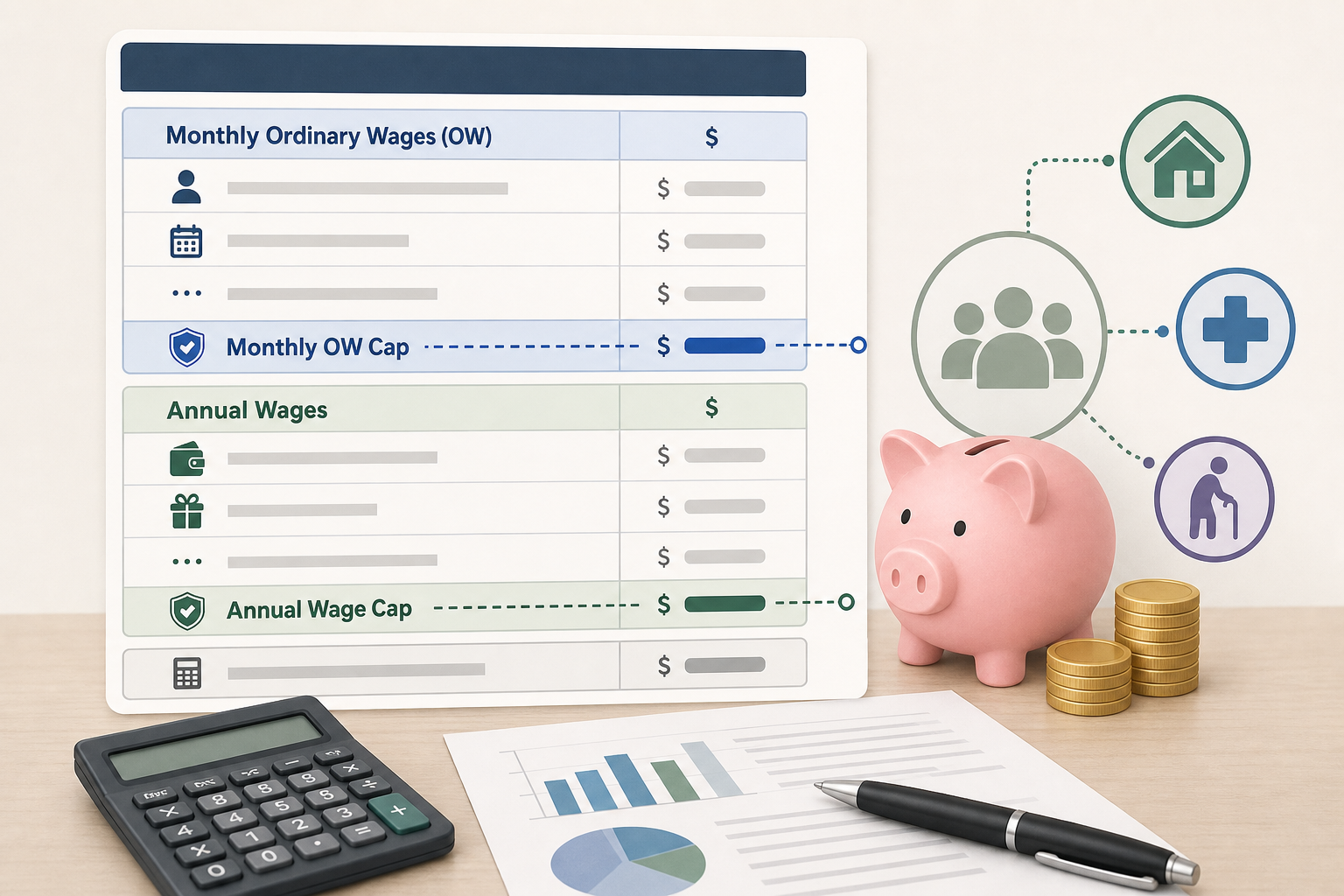
Most people know CPF contributions are capped, but fewer realise there are two distinct ceilings operating simultaneously. The Ordinary Wage (OW) Ceiling caps the monthly wages on which CPF contributions are calculated. The Annual Wage Supplement (AW) Ceiling caps contributions on additional payments such as bonuses. Both ceilings apply to Singapore citizens and permanent residents in employment, and both affect the employer's contribution as much as the employee's. Missing either one when running payroll means you are either over-deducting from an employee's pay or under-contributing as an employer, both of which create compliance problems. Understanding the two-ceiling structure is the foundation of getting CPF right.
The Ordinary Wage ceiling and how it works monthly
The OW Ceiling sets the maximum amount of ordinary wages in a single calendar month that attracts CPF contributions. Ordinary wages are the recurring payments tied to employment in that month: basic salary, allowances, and similar regular items. Any ordinary wages above the OW Ceiling are simply excluded from the CPF calculation for that month. For an employee earning above the ceiling, both the employer's contribution and the employee's deduction are each calculated only up to the ceiling amount. This matters practically: a payroll run that applies the full gross salary to the CPF rate without checking the ceiling will over-deduct from the employee and over-contribute as an employer. See how to calculate the exact contribution amounts once you have confirmed which wages fall within the ceiling.
The Annual Wage Supplement ceiling and bonus payments
Additional wages, most commonly the annual bonus or AWS (Annual Wage Supplement), are governed by a separate annual cap. The AW Ceiling is calculated as the difference between a fixed annual cap and the total ordinary wages already subjected to CPF contributions in that calendar year. In practice, this means an employee who has already contributed on a full year of ordinary wages at or near the ceiling will have little or no AW Ceiling remaining, so a year-end bonus may attract little or no CPF. Conversely, an employee who joined mid-year or who earns below the OW Ceiling for part of the year will have more AW Ceiling available. Employers must track both figures across the full calendar year, not just month by month, to apply the AW Ceiling correctly.
Why higher earners feel the ceiling most
For employees earning above the OW Ceiling, CPF contributions are calculated on a fixed wage base rather than their actual salary. This has two compounding effects. First, the employer's CPF contribution as a share of total remuneration is lower than it appears. Second, the employee's own CPF accumulation, across the Ordinary Account, Special Account, and MediSave Account, grows more slowly relative to their income. Over a career, that gap is meaningful for retirement planning, housing loan repayment capacity, and healthcare fund projections. Employees in this bracket often need to supplement CPF savings with other instruments. Understanding what employers contribute at each wage level helps both sides plan accurately.
Employer obligations and payroll compliance
Employers are legally responsible for computing and remitting CPF contributions correctly and on time each month. Applying the wrong ceiling, whether by ignoring it entirely or by applying it to the wrong wage components, is a compliance breach regardless of intent. The CPF Board can assess shortfalls, and late or incorrect contributions attract interest. For businesses running payroll in-house, the ceiling calculations must be updated whenever CPF Board revises the figures, which has happened in recent years as part of phased adjustments. Outsourcing to a managed payroll service means the provider carries the responsibility for keeping ceiling figures current and applying them correctly to each employee's specific wage structure every month.
Higher earners do not accumulate CPF proportionally on their full salary, and that gap compounds quietly into retirement.
How to apply the CPF ceilings correctly each payroll cycle
Classify each wage component correctly
Before any calculation, separate each payment into ordinary wages (regular, recurring, tied to the month of payment) and additional wages (bonuses, AWS, irregular payments). This classification determines which ceiling applies. Getting it wrong at this step cascades into every calculation that follows. When in doubt, the CPF Board's definitions of ordinary versus additional wages are the reference point.
Apply the OW ceiling to monthly ordinary wages
For each employee, check whether their ordinary wages for the month exceed the OW Ceiling. If they do, cap the CPF-liable amount at the ceiling figure and apply the applicable contribution rates to that capped amount, not the gross salary. Both the employer's contribution and the employee's deduction are calculated on the same capped base. Use the CPF contribution calculator to verify your figures.
Track cumulative ordinary wages across the calendar year
To apply the AW Ceiling correctly, you need a running total of the ordinary wages on which CPF has already been contributed for each employee since January. This cumulative figure is the input for calculating how much AW Ceiling remains. Maintain this running total in your payroll records and update it every month, not just when a bonus is due.
Calculate the AW ceiling before processing bonuses
When an additional wage payment is due, subtract the employee's year-to-date CPF-liable ordinary wages from the fixed annual cap to get the remaining AW Ceiling. CPF contributions on the bonus are capped at this remaining amount. If the remaining ceiling is zero or negative, no CPF is due on that additional wage payment. If it is positive, apply the contribution rates to whichever is lower: the actual bonus or the remaining ceiling.
Remit contributions by the deadline
CPF contributions must be paid to the CPF Board by the 14th of the following month (or the last working day before, if using electronic payment). Late payment attracts interest charges from the first day of the month the contributions were due. Ensure your payroll run is completed early enough to meet this deadline, particularly in months with public holidays that compress the processing window.
Update ceiling figures whenever CPF Board revises them
The OW Ceiling has been subject to phased increases in recent years. Whenever CPF Board announces a revision, update your payroll system before the effective date. Applying an outdated ceiling figure is a compliance error even if it was correct in the prior period. If you use a managed payroll provider, confirm they have a process for implementing CPF Board updates automatically.
Benefits
Avoid costly payroll compliance errors
Applying the OW and AW ceilings correctly protects employers from CPF Board assessments and interest charges on shortfalls. Incorrect ceiling application is a compliance breach regardless of whether the error favoured the employer or the employee.
Accurate retirement and housing planning
Employees earning above the OW Ceiling accumulate CPF on a capped wage base, not their full salary. Understanding this gap early allows higher earners to plan supplementary savings for retirement, housing loan repayment, and MediSave adequacy.
Correct bonus CPF treatment every year-end
The AW Ceiling resets each calendar year and varies by employee depending on their start date and ordinary wage history. Calculating it individually for each employee before processing bonuses prevents both over-deduction and under-contribution.
Reliable cost forecasting for employers
Knowing exactly which wage components are CPF-liable and up to what ceiling lets finance teams forecast total employment costs accurately, including the employer's CPF contribution as a line item in headcount budgets.
CPF ceiling scenarios that catch employers and employees off guard
Senior employee receiving a mid-year salary increase
A senior employee earning above the OW Ceiling receives a salary increase partway through the year. Because both the old and new salary exceed the ceiling, the CPF-liable amount does not change despite the pay rise. The employer's payroll system must confirm the ceiling is applied at the correct figure from the correct month, and the employee should understand that their CPF accumulation will not increase proportionally with their new salary.
Year-end bonus for an employee who joined mid-year
An employee who joined in July receives an annual bonus in December. Because they only contributed on ordinary wages for six months of the year, their cumulative CPF-liable ordinary wages are well below the annual cap. A significant AW Ceiling remains, meaning a larger portion of the bonus will attract CPF contributions compared to a full-year employee in the same salary band. Employers must calculate this individually for each employee rather than applying a blanket rule.
Overseas company hiring Singapore staff through an EOR
An overseas company without a Singapore entity hires a local employee through an Employer of Record arrangement. The EOR is the legal employer and is responsible for computing and remitting CPF contributions, including applying both ceilings correctly. The overseas company does not touch the CPF calculation directly, but should understand how the ceilings affect the total employment cost when budgeting for the hire. See what employers contribute at each wage level for a clearer picture of the cost structure.
Payroll manager switching to a new software system
A company migrating to new payroll software mid-year must ensure the new system carries over each employee's year-to-date CPF-liable ordinary wages accurately. If those figures are entered incorrectly, the AW Ceiling calculation for any bonus paid after the migration will be wrong. This is one of the more common sources of CPF errors during system transitions, and it warrants a line-by-line reconciliation before the first payroll run on the new platform.
CPF contribution ceiling questions answered
What is the difference between the Ordinary Wage ceiling and the Annual Wage Supplement ceiling?
The Ordinary Wage (OW) Ceiling is a monthly cap: it limits the amount of regular monthly wages on which CPF contributions are calculated in any single month. The Annual Wage Supplement (AW) Ceiling is an annual cap that applies specifically to additional wages such as bonuses, calculated as the fixed annual cap minus the total ordinary wages already subjected to CPF that calendar year. The two ceilings operate independently and must both be applied correctly in every payroll cycle.
Do CPF contribution ceilings apply to both the employer and employee portions?
Yes. Both the employer's CPF contribution and the employee's CPF deduction are calculated on the same capped wage base. If an employee's ordinary wages exceed the OW Ceiling, neither the employer nor the employee contributes on the amount above the ceiling. The ceiling applies symmetrically to both sides of the contribution.
What happens if an employer applies the wrong CPF ceiling?
Applying an incorrect ceiling is a compliance breach. If contributions are under-calculated, the CPF Board can assess the shortfall and charge interest from the date the contributions were originally due. Over-contributions can be refunded but require an administrative correction process. Employers are responsible for keeping ceiling figures current and applying them accurately each month.
How does the AW ceiling affect a bonus paid to a new employee?
An employee who joined partway through the year will have a higher remaining AW Ceiling than a full-year employee at the same salary, because less ordinary wages have been contributed on their behalf since January. This means more of their bonus may attract CPF contributions. Employers must calculate the remaining AW Ceiling individually for each employee, not apply a single figure across the team.
Does the CPF contribution ceiling apply to Employment Pass holders?
No. CPF contributions are only mandatory for Singapore citizens and permanent residents. Employment Pass holders, who are foreign professionals, are not subject to CPF contributions, so the contribution ceilings are not relevant to their payroll calculation. Employers should ensure their payroll system correctly identifies each employee's residency status before applying CPF rules.