
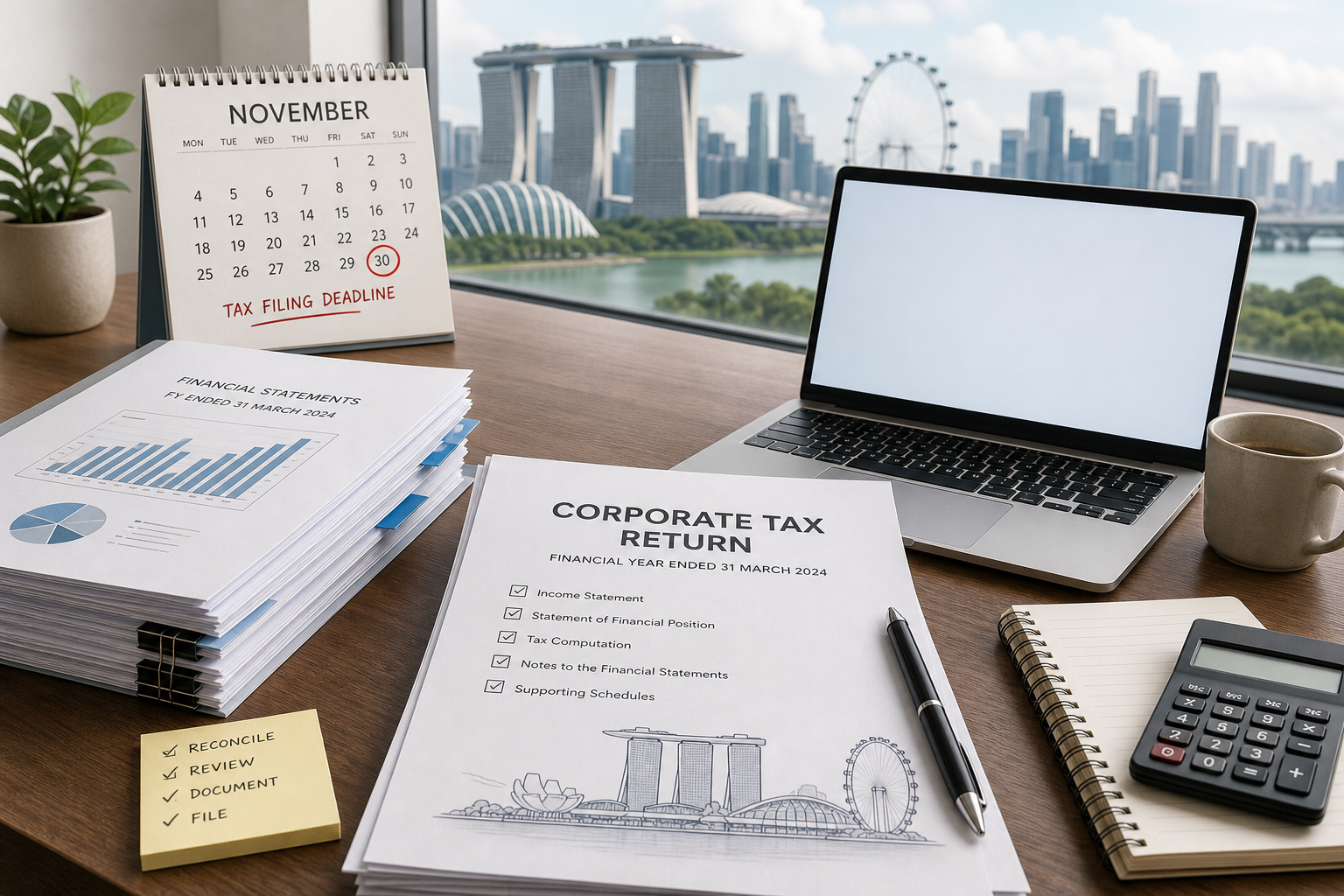
Form C is the full corporate income tax return
Every Singapore-incorporated company must file a corporate income tax return with the Inland Revenue Authority of Singapore (IRAS) each year. Form C is the standard, full-length version of that return, and it applies to companies whose tax affairs are too complex for the simplified alternatives. Where Form C-S and Form C-S (Lite) are designed for smaller, straightforward businesses, Form C is the version that handles the full range of income types, deductions, and tax adjustments a company might need to declare. Filing it correctly requires not just completing the return itself, but submitting full financial statements and detailed tax computation schedules alongside it. That combination makes accurate, up-to-date bookkeeping a prerequisite, not an afterthought.
Which companies must use Form C instead of the simpler versions
IRAS offers three versions of the corporate tax return: Form C-S (Lite), Form C-S, and Form C. The simplified versions are only available to companies that meet specific criteria, including an annual revenue threshold. Companies with annual revenue exceeding the threshold for Form C-S are required to file Form C, as are companies that claim certain tax adjustments or have more complex tax positions, such as capital allowances on specific asset classes, losses carried back, or group relief claims. If your company has foreign-sourced income, investment holding activities, or transactions that require detailed disclosure, Form C is almost certainly the right form. When in doubt, IRAS guidance and your tax adviser can confirm which version applies to your company's specific situation.
What you must submit together with Form C
Unlike Form C-S, which requires only the return itself, Form C filers must attach full financial statements and a detailed tax computation to their submission. The financial statements must reflect the company's accounts for the relevant financial year, prepared in accordance with the applicable accounting standards. The tax computation reconciles the accounting profit or loss to the taxable income figure declared on the return, adjusting for items that are taxable but not in the accounts, or deductible for tax but not in the accounts. Getting these schedules right is where most errors occur. Companies that maintain clean, complete bookkeeping throughout the year, rather than reconstructing records at year-end, are in a significantly stronger position when it comes to preparing these documents accurately and on time.
Deadlines, e-filing, and what happens if you miss them
IRAS sets an annual deadline for corporate income tax returns. Paper filing carries an earlier deadline, while e-filing through myTax Portal is given a later cut-off, typically 30 November for paper and a later date for electronic submission. IRAS strongly encourages e-filing, and most companies file electronically. Missing the deadline can result in penalties, and IRAS may issue estimated assessments if a return is not received. Once an estimated assessment is issued, disputing it requires additional administrative steps. Filing on time, even if the figures need to be revised later, is generally the better approach. Companies that have not yet filed their Estimated Chargeable Income (ECI) separately should note that ECI and Form C are distinct obligations with different deadlines. See the ECI filing guide for more on that requirement.
How accurate bookkeeping connects directly to Form C
Form C is ultimately only as good as the financial records behind it. The tax computation that accompanies Form C is built directly from the company's accounts, so errors or gaps in the bookkeeping flow through into the return. Companies that use proper accounting software, reconcile their accounts regularly, and prepare financial statements to the required standard will find the Form C process significantly more manageable. For companies that have let their books fall behind, the period before the filing deadline can become a scramble. Engaging an accounting or corporate tax service provider early in the financial year, rather than at year-end, is the most practical way to avoid that situation. Duellix handles bookkeeping through Xero and prepares the financial statements and tax filings that Form C requires.
Form C is ultimately only as good as the financial records behind it: the tax computation is built directly from the company's accounts.
How to prepare and file Form C step by step
Confirm Form C applies to your company
Check whether your company's annual revenue and tax position require Form C rather than Form C-S or Form C-S (Lite). If your revenue exceeds the threshold for the simplified forms, or if you are claiming adjustments such as group relief, loss carry-back, or specific capital allowances, Form C is the required version. Review IRAS guidance or consult your tax adviser to confirm before you begin preparing the return.
Close off and finalise your financial accounts
Form C requires full financial statements, so your accounts for the relevant financial year must be complete and accurate before you can prepare the return. Reconcile all accounts, ensure all income and expenses are recorded, and prepare the financial statements in accordance with the applicable accounting standards. Companies using Xero or another accounting platform should run a final review of all transactions and bank reconciliations for the year.
Prepare the tax computation
The tax computation is a separate schedule that adjusts your accounting profit or loss to arrive at the taxable income figure. Add back any expenses that are not deductible for tax purposes, and deduct any allowances or exemptions your company is entitled to claim, such as the start-up tax exemption or partial tax exemption, capital allowances, and any applicable reliefs. This document must be attached to the Form C submission.
Complete Form C on myTax Portal
Log in to IRAS's myTax Portal using your company's Corppass credentials and complete the Form C fields. The return requires you to declare the company's income, deductions, and the taxable income figure from your tax computation. E-filing is the recommended method and carries a later deadline than paper filing. Ensure all figures match your financial statements and tax computation before submitting.
Attach and submit supporting documents
Upload the full financial statements and tax computation as attachments to your Form C submission. Some companies may also need to attach additional schedules depending on the nature of their income or the reliefs claimed. Double-check that all required attachments are included before you confirm the submission, as an incomplete filing can trigger follow-up queries from IRAS.
Respond to any IRAS queries and retain records
After filing, IRAS may issue a Notice of Assessment or raise queries about specific items in the return. Retain all supporting records, including invoices, contracts, and accounting workpapers, for at least five years in case IRAS requests them. If you disagree with an assessment, there is a formal objection process with a defined timeline, so act promptly if a dispute arises.
Benefits
Avoid penalties for late or incorrect filing
IRAS can impose penalties for late submission and may issue estimated assessments if a return is not received. Filing Form C accurately and on time is the most direct way to avoid these consequences and the administrative burden of disputing an estimated assessment.
Claim every deduction and relief you are entitled to
Form C's detailed tax computation is where capital allowances, loss carry-backs, group relief, and other adjustments are formally claimed. A well-prepared tax computation ensures your company does not overpay tax by missing deductions it is legally entitled to.
Build a clean audit trail for IRAS queries
IRAS can raise queries on filed returns for up to five years. Maintaining complete, well-organised records that align with the figures in your Form C submission means you can respond to any query quickly and confidently.
Connect tax filing to accurate financial statements
Form C requires full financial statements as an attachment, which means the filing process also produces a set of accounts that directors and shareholders can rely on. Accurate financial statements prepared for Form C serve multiple purposes, from internal management decisions to banking and investor requirements.
Form C in practice: situations where it applies
A growing SME that has crossed the revenue threshold
A Singapore private limited company that started out filing Form C-S finds that its annual revenue has grown beyond the threshold for the simplified form. From the next filing cycle, it must switch to Form C, which means preparing and attaching full financial statements and a detailed tax computation. The company's bookkeeper needs to ensure the accounts are closed off to the required standard, not just the summary figures that were sufficient for Form C-S.
A company claiming group relief or loss carry-back
A Singapore company that is part of a group wants to transfer unabsorbed losses to a related company under the group relief scheme. Group relief is one of the adjustments that triggers a Form C requirement, regardless of revenue size. The tax computation must set out the relief claimed in detail, and the return must be filed as Form C rather than the simplified alternatives.
An investment holding company with multiple income streams
A company that holds investments and receives dividend income, rental income, and interest from related entities has a more complex tax position than a straightforward trading company. Investment holding activities and mixed income streams typically require Form C, as the tax treatment of each income type must be declared separately. The financial statements must reflect all these streams clearly for the tax computation to be accurate.
A foreign-owned company with foreign-sourced income
An overseas founder's Singapore entity receives income from both local clients and foreign sources. Foreign-sourced income that is remitted to Singapore may be taxable, and the conditions for exemption must be assessed and documented. Declaring foreign-sourced income correctly requires Form C, and the tax computation must address the applicable exemptions or tax credits. Companies in this situation benefit from engaging a tax adviser early to ensure the right treatment is applied.
Form C Singapore: common questions answered
What is the difference between Form C, Form C-S, and Form C-S (Lite)?
All three are versions of Singapore's corporate income tax return filed with IRAS, but they differ in scope and eligibility. Form C-S (Lite) and Form C-S are simplified versions available only to companies that meet specific criteria, including a revenue ceiling and restrictions on the types of income and adjustments they can declare. Form C is the full-length return required for companies that exceed those thresholds or have more complex tax positions, and it must be accompanied by full financial statements and a detailed tax computation.
When is the deadline to file Form C in Singapore?
IRAS sets an annual deadline for corporate income tax returns. Paper filing carries an earlier deadline, while e-filing through myTax Portal is given a later cut-off, with 30 November being the standard paper filing deadline. IRAS strongly encourages e-filing, and most companies submit electronically to take advantage of the extended deadline. Missing the deadline can result in penalties and estimated assessments.
Does Form C need to be filed even if the company made a loss?
Yes. A Singapore company must file its corporate income tax return regardless of whether it made a profit or a loss for the year. Filing a return showing a loss also allows the company to formally record those losses, which may be available for carry-forward or carry-back against future or past profits under IRAS rules.
What documents must be attached to Form C?
Form C filers must attach full financial statements and a detailed tax computation to their submission. The financial statements must cover the relevant financial year and be prepared to the applicable accounting standard. The tax computation reconciles the accounting profit or loss to the taxable income figure declared on the return, adjusting for non-deductible expenses, capital allowances, and any reliefs claimed.
Is Form C the same as the Estimated Chargeable Income (ECI) filing?
No, they are separate obligations. ECI is an estimate of the company's taxable income filed within three months of the financial year-end, before the full accounts are finalised. Form C is the complete annual tax return filed later, with full financial statements and a detailed tax computation attached. Both must be filed, and they have different deadlines. See the ECI filing guide for more detail on that requirement.