
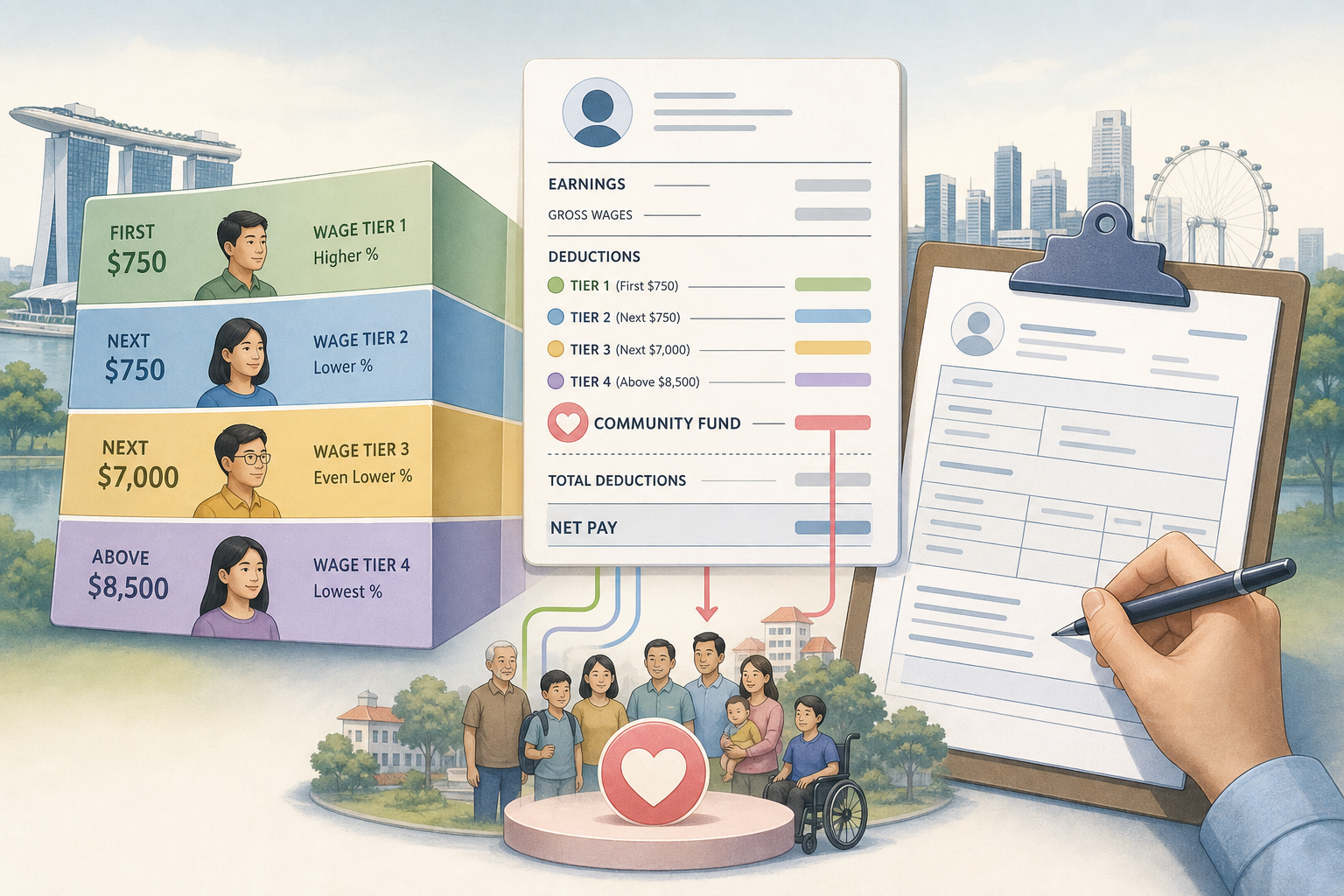
What the CDAC contribution actually is
The Chinese Development Assistance Council (CDAC) contribution is a mandatory monthly deduction from the wages of eligible Chinese Singaporean employees. It is collected alongside CPF contributions and remitted to the CPF Board, which passes the funds to CDAC. The money finances educational support, social assistance, and community uplift programs for the Chinese community in Singapore.
CDAC is one of four self-help group (SHG) funds in Singapore, each aligned to an ethnic community: CDAC for the Chinese community, MENDAKI for the Malay community, SINDA for the Indian and other minority communities, and the Eurasian Community Fund (ECF) for Eurasians. Every eligible employee contributes to the SHG that corresponds to their ethnic group, not to all four.
Who is required to contribute each month
The obligation applies to employees who are Singapore citizens or permanent residents of Chinese ethnicity and who earn CPF-liable wages. If an employee falls into this category, the deduction is compulsory by default, and the employer is legally required to make it.
Employers do not get to decide whether to apply the deduction. The legal framework places the duty on the employer to deduct the correct amount from the employee's wages and remit it together with the monthly CPF contribution. Omitting or under-deducting is a compliance failure, not a discretionary choice. Employers who already use a structured payroll service will typically have CDAC deductions built into their payroll run automatically.
How the tiered rate structure works
CDAC contribution rates are tiered by gross monthly wage, so lower-income earners pay smaller absolute amounts and higher earners pay more. The tiers are defined by wage bands, and the applicable rate is determined by where the employee's gross monthly wage falls within those bands.
The key points to understand about the rate structure: first, it is the employee's gross monthly wage, not take-home pay, that determines the tier. Second, the contribution is deducted from the employee's wages, not added on top by the employer. Third, the rates are set by CDAC and reviewed periodically, so employers should verify the current schedule with the CPF Board or CDAC directly rather than relying on historical figures. For context on how CPF itself is calculated alongside these deductions, the CPF contribution calculator guide walks through the mechanics in detail.
The opt-out option and how it works in practice
Despite being compulsory by default, employees can formally opt out of contributing to CDAC and redirect their SHG contribution to another eligible self-help group fund instead. This is not an exemption from the deduction entirely; it is a redirection. The employee must submit a waiver form, and until that form is processed, the standard CDAC deduction continues to apply.
Employers should note that it is the employee's responsibility to initiate the opt-out, not the employer's. If an employee submits a valid waiver, the employer must update payroll accordingly from the effective date stated on the waiver. Running a clean payroll process means keeping waiver records on file so that deductions reflect each employee's current election.
How CDAC remittance fits into the CPF payment cycle
CDAC contributions are remitted through the same CPF payment cycle that employers already use for monthly CPF contributions. The CPF Board collects the SHG contributions on behalf of CDAC and the other self-help groups, so there is no separate payment channel to manage.
The CPF payment deadline applies: contributions for a given month must be submitted by the 14th of the following month (or the next working day if the 14th falls on a weekend or public holiday). Late payment attracts interest and potential penalties under the CPF Act, the same rules that govern late CPF contributions. Employers who understand CPF employer contribution obligations will find CDAC remittance slots naturally into the same compliance rhythm.
An employee can opt out of CDAC specifically, but the deduction is redirected to another eligible fund, not eliminated: the SHG contribution obligation itself remains.
How CDAC contributions are handled month to month
Identify eligible employees each month
At the start of each payroll run, confirm which employees are Singapore citizens or permanent residents of Chinese ethnicity and are earning CPF-liable wages. New hires should be assessed at onboarding so their SHG contribution category is set up correctly from their first payroll cycle. Ethnicity and citizenship status are the two key variables; both must be present for CDAC to apply.
Check for any active opt-out waivers
Before calculating deductions, verify whether any eligible employee has submitted and had approved an opt-out waiver redirecting their contribution to a different SHG fund. Keep a record of each waiver's effective date. Applying CDAC deductions to an employee who has validly opted out is a payroll error that will need to be corrected, so maintaining an up-to-date waiver register matters.
Determine the applicable rate by wage tier
Look up each eligible employee's gross monthly wage and identify the corresponding CDAC contribution tier. The rate is fixed by the wage band the employee falls into, not a percentage of wages, so a small change in gross pay can shift an employee into a different tier. Confirm the current rate schedule from the CPF Board or CDAC directly, as rates are subject to revision.
Deduct the amount from employee wages
The CDAC contribution is an employee-side deduction, taken from the employee's gross wages, not an additional employer cost. Apply the deduction in the payroll calculation alongside CPF employee contributions. The payslip should clearly show the CDAC line item so employees can see what has been deducted.
Remit via the CPF payment channel
Submit the CDAC contribution together with monthly CPF contributions through the CPF Board's payment system. The CPF Board distributes the SHG funds to CDAC on the employer's behalf. The deadline is the 14th of the month following the month of wages; missing it triggers the same late-payment interest that applies to overdue CPF contributions. See the CPF employer contributions guide for the full payment process.
Retain records for audit and compliance
Keep payroll records showing CDAC deductions, wage amounts, and any waiver documents for each employee. Singapore's employment legislation requires employers to retain payroll records, and these records are the evidence base if a deduction is ever queried by an employee or a regulator. A clean paper trail is the simplest defence against a compliance dispute.
Benefits
Deduction is employee-side, not an employer cost
CDAC contributions are taken from the employee's gross wages, not added as an employer expense on top of salary. Employers facilitate the deduction and remittance but do not bear the cost themselves.
Remittance uses the existing CPF channel
There is no separate payment system to set up. CDAC contributions are submitted through the CPF Board's existing payment infrastructure, alongside monthly CPF contributions, keeping compliance within one workflow.
Opt-out redirects rather than eliminates the deduction
Employees who opt out do not escape the SHG contribution altogether. The amount is redirected to another eligible self-help group fund, so the employer's payroll obligation continues; only the destination changes.
Rates are tiered, protecting lower-wage earners
The tiered wage-band structure means lower-income employees pay smaller absolute amounts. Employers with a mixed-wage workforce will see different CDAC deduction amounts across their payroll, all determined by each individual's gross monthly wage.
CDAC contribution scenarios in practice
A new hire joins at a low monthly wage
A Chinese Singaporean employee joins a company earning a gross monthly wage that falls in the lowest CDAC tier. The employer sets up payroll, confirms no opt-out waiver is in place, and applies the lowest applicable CDAC rate. The deduction is small in absolute terms but is still mandatory, and the employer must remit it through the CPF channel by the 14th of the following month. Missing the deduction entirely, even for a small amount, is still a compliance failure.
An employee submits an opt-out waiver mid-year
A Chinese Singaporean employee decides partway through the year to redirect their SHG contribution to a different eligible fund. They submit the required waiver form, which specifies an effective date. From that effective date, the employer must stop deducting for CDAC and apply the contribution to the redirected fund instead. Deductions made before the effective date are not reversed; only future deductions change.
An overseas company hires a Singapore-based Chinese employee
An overseas company without a Singapore entity uses an Employer of Record arrangement to hire a Chinese Singaporean employee locally. The EOR, acting as the legal employer, is responsible for all payroll compliance, including CDAC deductions and CPF remittance. The overseas company does not handle the deduction directly; the EOR carries the legal obligation. This is a common structure for companies expanding into Singapore before incorporating a local entity.
A higher-earning employee crosses a wage tier boundary
An employee receives a salary increment that moves their gross monthly wage from one CDAC tier into the next. The CDAC deduction increases from the month the new wage takes effect, not from the start of the year. The employer's payroll system should recalculate the applicable tier each month based on that month's gross wage, not carry forward a prior tier indefinitely.
Common questions about CDAC contributions
Does the employer pay CDAC contributions, or does the employee?
The CDAC contribution is an employee-side deduction: it comes out of the employee's gross wages. The employer's role is to deduct the correct amount and remit it to the CPF Board on the employee's behalf. Unlike CPF employer contributions, CDAC does not represent an additional cost to the employer.
What happens if an employer forgets to deduct CDAC contributions?
Failing to deduct and remit CDAC contributions is a compliance failure under the legal framework that governs SHG contributions. The employer remains liable for the amounts that should have been remitted. Late or missed remittances attract the same interest and penalty rules that apply to overdue CPF contributions, so the error is not simply written off.
Can an employee stop paying CDAC contributions entirely?
No. An employee can opt out of contributing to CDAC specifically, but the deduction is redirected to another eligible self-help group fund, not eliminated. The SHG contribution obligation itself remains; only the recipient fund changes when a valid waiver is in place.
How does CDAC contribution interact with CPF filing deadlines?
CDAC contributions share the same monthly deadline as CPF contributions: the 14th of the month following the month in which wages are paid. Both are submitted through the CPF Board's payment system in a single filing. Employers who are already on top of their CPF employer contribution obligations will find CDAC slots into the same routine.
Does CDAC apply to foreign employees working in Singapore?
No. CDAC contributions apply only to Singapore citizens and permanent residents of Chinese ethnicity who earn CPF-liable wages. Foreign employees, including Employment Pass and S Pass holders, are not subject to CPF contributions and therefore are not subject to CDAC deductions either.